Summary
Analysis score
Average of the criteria rated below
Value: strong spec sheet with the usual unknown-brand trade-offs
Design: classic diver with a blue fumé twist
Comfort and wearability: what the specs and one review suggest
Materials and build choices: where the money seems to go
Durability: built to take a beating, at least on paper
Performance and movement: what to expect day to day
What the Cestrian Pro Dive 42mm actually is
Pros
- Strong spec sheet for a diver: 300 m water resistance, ceramic bezel, sapphire with triple AR, Swiss Super-LumiNova
- Proven Miyota 8215 automatic movement with hacking seconds and ~42 hours power reserve
- Five-link bracelet with taper and on-the-fly ratcheting clasp extension, praised by the existing buyer
- Blue grain-textured fumé dial with applied markers for better visual interest and legibility
Cons
- Very limited customer feedback and an unknown brand, so long-term reliability and support are unclear
- Miyota 8215 accuracy range (–20 to +40 s/day) is only average and not for precision-obsessed users
- Push-pin bracelet links instead of screw links, which some buyers see as less premium

Specifications
View full product page →| Brand | Cestrian |
A serious dive spec from a brand few people know
The Cestrian Pro Dive 42mm positions itself as a fairly serious mechanical dive watch, at least on paper. You get a 42 mm stainless steel case, 300 metres of water resistance, a ceramic bezel and sapphire crystal with triple anti-reflective coating. That’s the kind of spec list usually pushed by established microbrands or entry-level models from mainstream names, not by a brand that most people have never heard of. The watch uses a Japanese automatic movement, the Miyota 8215, which is a very common workhorse in affordable mechanical watches. So the overall approach looks familiar: proven, low-risk movement and money spent on materials and features that users actually see and touch.
Where this model tries to stand out is with its blue fumé dial and five-link bracelet with on-the-fly clasp extension. The single published Amazon review gives it 5/5 and highlights the dial texture and the clasp as key positives. That’s obviously far from enough feedback to build strong conclusions, but it at least shows one verified buyer is satisfied with the overall package. The watch sits in a crowded segment where Seiko, Citizen, Orient and dozens of microbrands already offer solid dive-style automatics.
In my opinion, the main interest of this Cestrian is the mix of specs usually seen a bit higher in price: ceramic bezel, sapphire with AR, 300 m rating and a bracelet with ratcheting extension. The downside is the lack of brand reputation and almost no long-term user feedback. If something goes wrong with quality control or after-sales service, there’s not much history to rely on. So this is a product that looks very good on paper, but buyers are taking a bit of a bet on the name behind it.
For someone who cares about specs more than logo prestige, this watch could be appealing. For someone who wants a track record, established service network and lots of user feedback, it’s probably safer to look at bigger brands. The rest of this analysis digs into what the sheet and the lone review really suggest in terms of design, performance, durability, comfort, and overall value.
Value: strong spec sheet with the usual unknown-brand trade-offs
The price is not displayed here, but judging by the movement choice (Miyota 8215), materials (sapphire, ceramic, Super-LumiNova) and the way the single Amazon review talks about the bracelet and clasp “at this price”, it’s safe to say this is positioned as an affordable or mid-range dive watch rather than a premium piece. On paper, the spec sheet is aggressive: 300 m water resistance, ceramic bezel, sapphire with triple AR, Swiss Super-LumiNova, and a bracelet with on-the-fly ratcheting extension. Many well-known brands cut at least one of those corners in their cheaper divers, especially the clasp and ceramic bezel.
The main value risk is the brand itself. Cestrian is not a widely recognised name, and there are almost no reviews. That means there’s limited information on long-term reliability, quality control consistency, and after-sales service. If something goes wrong, buyers can’t lean on decades of brand history or a large service network like they can with Seiko, Citizen or Orient. Some people don’t care about the logo as long as they like the watch, but others see brand reputation as part of the value proposition.
From a pure specs perspective, this watch competes well with popular microbrands and even undercuts some big-name divers in terms of features per euro. The on-the-fly clasp in particular is often missing even on more expensive models. The single Amazon review is very positive (5/5), praising the dial texture and calling the clasp impressive for the price, which suggests at least one owner feels they got good value. Still, one satisfied buyer does not make a pattern.
In my opinion, the Cestrian Pro Dive 42mm offers good value on paper if someone prioritises features and materials and is comfortable taking a chance on a lesser-known name. The risk premium is mainly about unknown long-term support and resale value, which is likely low compared with established brands. For someone who just wants a well-specced diver to wear and doesn’t plan to resell, the package looks attractive. For someone who sees a watch partly as an investment or wants rock-solid brand backing, it makes more sense to pay more for a known manufacturer, even if that means compromising on certain specs like ceramic or clasp features.
Design: classic diver with a blue fumé twist
The design direction is very clear: classic dive watch with a modern dial treatment. A 42 mm round case in 316L steel, rotating unidirectional bezel, screw-down crown at 3 o’clock, and a steel bracelet is a tried-and-true layout. It’s not trying to reinvent the diver genre; it’s going after the formula that works and adding its own flair via the fumé blue dial and the bracelet/clasp setup. The blue grain-textured matte dial should keep reflections under control while giving some visual interest compared with flat sunburst dials. One reviewer specifically points out that the dial doesn’t look flat and calls the texture “really nice” and “interesting and dynamic”, while still not being distracting. That gives a hint that Cestrian didn’t overdo the effect.
The applied markers with polished surrounds are a common way to add depth and catch light at different angles. Combined with the fumé effect, this may give the watch a more upscale look than a simple printed dial. The ceramic bezel insert is also a design statement: ceramic tends to keep its gloss and colour over time, which often makes the bezel the visual focal point alongside the dial. The luminous triangle at 12 on the bezel is standard diver code and also a practical detail for timing.
The five-link bracelet is a bit of a departure from the usual three-link Oyster-style bracelets. Five-link designs can look slightly dressier or more intricate. Depending on taste, some people will find it more visually interesting, others might prefer a simpler look. The bracelet tapers from 22 mm to 18 mm at the clasp, which usually makes the watch look less bulky and more balanced on the wrist. The fact that the Amazon review calls the bracelet “simple, push pins but all good at this price” suggests a no-nonsense approach: no fancy quick-release or screw links, just a standard but functional layout.
In my opinion, the overall design is conservative but not boring. It ticks all the dive-watch design boxes and adds enough detail (fumé texture, applied indices, five-link bracelet) to avoid looking generic. The logo and brand name don’t have the recognition of Seiko or Citizen, so the watch has to stand on its design and specs alone. If someone wants a low-key diver with a bit of visual character, this layout makes sense. If someone wants something very original or dressy, this is probably too tool-oriented and conventional.
Comfort and wearability: what the specs and one review suggest
Comfort is harder to judge without many user reports, but there are clues. The watch has a 42 mm diameter and 13.8 mm thickness, which puts it in the medium-to-large diver category. On average wrists, that should have a noticeable presence without being absurdly large. The 22 mm lug width with a taper down to 18 mm at the clasp is usually a good sign for comfort: a bracelet that narrows tends to feel less bulky and more balanced. For people with smaller wrists, 42 mm might feel big, while those used to dive watches from Seiko or Citizen will find it pretty standard.
The five-link bracelet, by design, should articulate more than a blocky three-link bracelet. More, smaller links often mean better conformity to the wrist shape. The downside is that sizing can be a bit more fiddly, especially with push pins instead of screws. The Amazon buyer explicitly mentions that the bracelet uses push pins but says it’s “all good at this price”, which implies no major complaints about fit or feel from that person. However, that’s only one data point, so it’s far from a consensus.
The clasp has a push-button diver’s closure with ratcheted extension. This is a real comfort asset. A ratcheting or on-the-fly extension allows quick micro-adjustment without tools, which is useful not only for wetsuits but also for daily wear when the wrist expands in warm weather. The reviewer calls the on-the-fly clasp “wild” at this price, clearly seeing it as a strong point. In practice, such a clasp can make the difference between a watch that feels tight or loose at different times of day and one that always feels reasonably dialed in.
There is no mention of sharp edges, hair-pulling, or clasp discomfort in the existing review. Without additional feedback, it’s impossible to claim broad comfort consensus. In my opinion, the dimensions and bracelet design suggest average to good comfort for people used to 42 mm divers. Those with very small wrists or who prefer slim dress watches might find it a bit chunky. For dive-watch fans, the combination of tapering bracelet and adjustable clasp looks like a sensible setup on paper.

Materials and build choices: where the money seems to go
The material choices are one of the strong points of this watch on paper. The case and bracelet are 316L stainless steel, which is standard but proven. 316L offers good corrosion resistance, especially important for saltwater use. The watch uses a flat sapphire crystal with triple anti-reflective coating. Sapphire is far more scratch-resistant than mineral glass or acrylic. Triple AR coating should cut reflections significantly, which is useful both outdoors and under artificial lighting. The fact that AR is mentioned explicitly is interesting, as some budget brands skip it entirely.
The bezel insert is ceramic, not aluminium. That’s a key distinction in this price segment. Ceramic is hard and very resistant to scratches, and it tends to keep its colour and shine for years. Aluminium bezels can fade and scratch easily. So if someone wants a diver that still looks clean after a lot of daily wear, ceramic is a real advantage. The bezel has 120 clicks, which is the standard for more precise alignment versus 60-click bezels, and often seen as a quality marker by watch enthusiasts.
On the lume side, the watch uses Swiss Super-LumiNova on hands, markers and the bezel triangle. Super-LumiNova is not a single formula, but in general it’s a reliable modern luminous compound. The spec doesn’t say which grade (C1, BGW9, C3, etc.), so it’s impossible to guess actual brightness or longevity. Still, the fact that Cestrian calls it out suggests they didn’t go with the cheapest anonymous lume paint. For a dive-style watch, good lume is almost mandatory, so at least on paper this part looks serious.
The movement, Miyota 8215, is not a premium material story but a practical choice. It’s a widely used Japanese automatic calibre with a solid track record for durability. It won’t impress movement snobs who prefer higher-beat or more decorated calibres, but for a robust daily diver, it’s a reasonable pick. The bracelet uses push pins rather than screw links, as mentioned by the Amazon buyer. That’s a cost-cutting choice, but very common in this range. It’s not glamorous, but it works if done correctly.
In my opinion, the materials are allocated in a smart way: money spent on sapphire, ceramic and lume, and savings on less visible aspects like bracelet link construction. There’s nothing here that screams luxury, but there’s also nothing that looks out of place for a serious tool watch. If the actual assembly quality matches the spec, the materials should hold up well to normal use and occasional diving or swimming.
Durability: built to take a beating, at least on paper
The durability story leans heavily on the materials and construction choices. 316L stainless steel is corrosion-resistant and widely used in dive watches, so case and bracelet should handle sweat, rain and occasional saltwater without major issues, as long as the watch is rinsed after sea exposure. The sapphire crystal is a big plus for durability: it’s highly resistant to scratches from everyday objects like keys or door frames. Many cheaper watches use mineral glass, which marks more easily, so sapphire is a clear upgrade if long-term clarity matters.
The ceramic bezel insert is another strong point for durability. Ceramic is much harder than aluminium; it resists scratches very well and doesn’t fade as quickly under UV light. The trade-off with ceramic is that it can be more brittle if hit very hard, but that usually takes a significant impact. For normal daily use, ceramic tends to look fresh for years, which helps keep the watch looking newer. The 120-click mechanism hints at a more precise bezel assembly, though actual feel and robustness can’t be judged from specs alone.
Water resistance is rated at 300 metres, supported by screw-down crown and solid screw-down caseback. That construction, if properly executed with quality gaskets, should protect the movement against moisture and pressure. It also helps block dust and sweat from entering the case, which is important for longevity. There are no user reports yet of leaks or failures, so there’s no clear evidence either way on long-term water performance. Still, 300 m is well above what most owners will ever put it through, giving a good safety margin.
The Miyota 8215 movement has a long track record in the industry. It’s not glamorous, but it’s known for durability and ease of servicing. Many watchmakers are familiar with it, and parts are widely available. That’s a quiet but important durability factor: if the watch ever needs servicing, it won’t be exotic or hard to repair. The bracelet uses push pins, which are less robust than screw bars in extreme abuse but perfectly adequate for normal wear. The lone Amazon review does not report any early failures, but that’s too little data for solid conclusions. In my opinion, if the factory assembly is consistent, the chosen components suggest good durability for everyday and recreational diving use, in line with other serious dive watches in the same bracket.

Performance and movement: what to expect day to day
Performance here mainly revolves around three aspects: timekeeping, water resistance, and legibility/functionality. The Miyota 8215 movement is listed with a typical accuracy of –20 to +40 seconds per day and around 42 hours of power reserve. That range is standard for this calibre. In reality, individual watches can run tighter or looser, but anyone expecting chronometer-level precision is looking in the wrong price bracket. For most users, losing or gaining under a minute per day is acceptable, especially if they reset the watch every few days. The hacking seconds feature is useful for setting time precisely, which not all older or cheaper autos offer.
On water resistance, the watch is rated to 300 metres with screw-down crown and screw-down caseback. That rating is more than enough for swimming, snorkeling and recreational diving. The construction described (solid caseback, screw-down crown) is standard for dive watches. Obviously, real-world resistance also depends on gaskets and assembly quality, which are not detailed, and there are not yet multiple user reports of deep water use. But on paper, the watch is built to handle serious water exposure and pressure changes better than the typical 100 m “swim proof” casual watch.
Legibility and functionality come from the blue matte fumé dial, applied markers, and Super-LumiNova on both the dial and bezel pip. The matte texture should help avoid glare under strong light, while the AR-coated sapphire further reduces reflections. The unidirectional 120-click bezel is meant for timing dives or any 60-minute event. The 120 clicks allow more precise alignment than 60-click bezels, which some users prefer for accuracy when measuring elapsed time. The luminous bezel triangle is another practical detail for low-light timing.
The single Amazon review does not comment on accuracy or water performance, focusing instead on dial appearance and bracelet/clasp. So there is no broad user confirmation yet on how this watch behaves in daily life or underwater. In my opinion, given the components used, the performance should be solid but not exceptional: a reliable workhorse movement, more water resistance than most people need, and functional dive-watch readability. Enthusiasts who obsess over ±5 seconds per day and perfect bezel alignment might be more critical, but general users will likely find the specs more than adequate for everyday and recreational use.
What the Cestrian Pro Dive 42mm actually is
On paper, the Cestrian Pro Dive is a 42 mm automatic diver-style watch aimed at people who want a mechanical watch they can swim or dive with. The case is 316L stainless steel, the industry standard for corrosion-resistant watch cases. Thickness is listed at 13.8 mm, which is fairly typical for a 300 m-rated diver with an automatic movement. It has a screw-down crown and screw-down caseback, the classic combo to reach the advertised 300 metres of water resistance. That’s more than enough for recreational scuba and certainly more than most owners will ever need.
The dial is blue with a grain-textured, matte fumé finish, which should help with legibility by cutting reflections. Applied hour markers with polished surrounds and Swiss Super-LumiNova on hands, markers and bezel pip indicate a clear focus on readability in low light and underwater. Display is analog, with a unidirectional 120-click ceramic bezel for timing. Ceramic is harder and more scratch-resistant than aluminium inserts commonly seen at the low end, which is a good sign if the goal is a watch that doesn’t look beaten up quickly.
Inside, Cestrian went with the Miyota 8215, a Japanese automatic movement with hacking seconds and around 42 hours of power reserve. The typical accuracy range given is –20 to +40 seconds per day. That’s not chronometer level and not even high-end microbrand territory, but it’s standard for this movement and widely accepted at this price level. It’s a workhorse: not glamorous, but easy to service and known by many watchmakers.
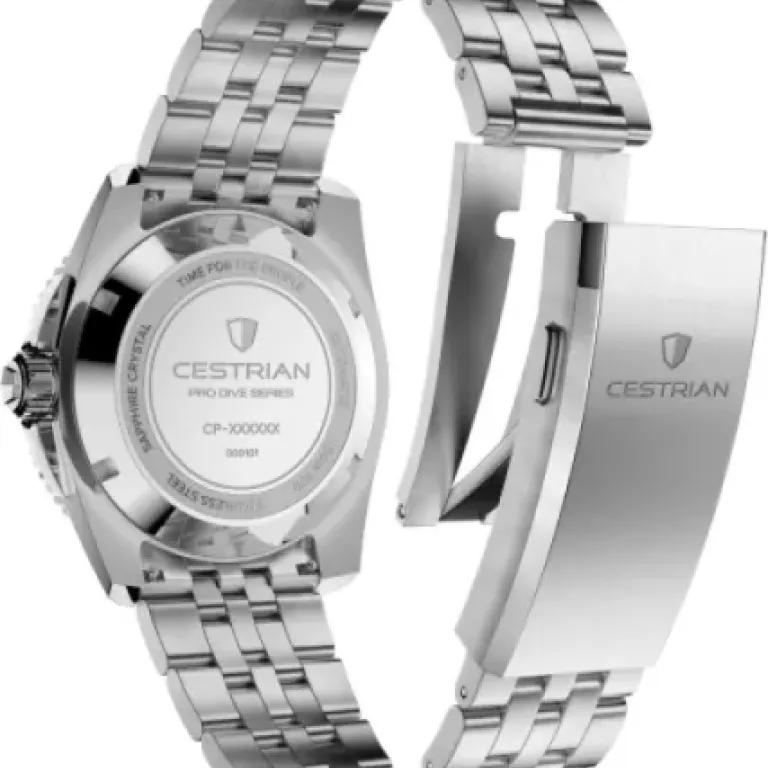
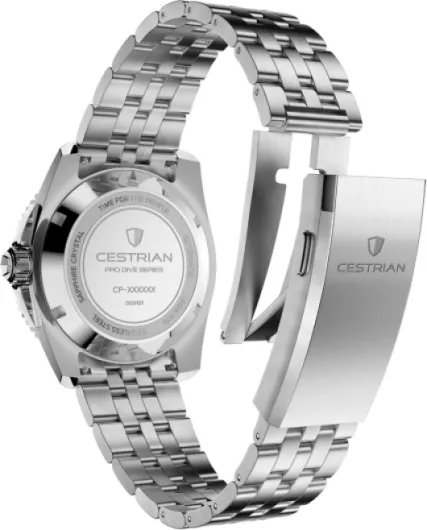
The watch comes on a five-link stainless steel bracelet that tapers from 22 mm at the lugs to 18 mm at the clasp. The clasp is a push-button diver’s clasp with a ratcheted extension, which allows micro-adjustments on the fly, either for wetsuit use or simple daily comfort when the wrist swells. Package dimensions are 30 x 30 x 10 cm and 500 g, which suggests a fairly standard watch box, nothing fancy mentioned. Overall, the presentation is that of a serious spec dive watch sold by a lesser-known brand, leaning hard on materials and features to justify its place in a crowded market.
Pros
- Strong spec sheet for a diver: 300 m water resistance, ceramic bezel, sapphire with triple AR, Swiss Super-LumiNova
- Proven Miyota 8215 automatic movement with hacking seconds and ~42 hours power reserve
- Five-link bracelet with taper and on-the-fly ratcheting clasp extension, praised by the existing buyer
- Blue grain-textured fumé dial with applied markers for better visual interest and legibility
Cons
- Very limited customer feedback and an unknown brand, so long-term reliability and support are unclear
- Miyota 8215 accuracy range (–20 to +40 s/day) is only average and not for precision-obsessed users
- Push-pin bracelet links instead of screw links, which some buyers see as less premium
Conclusion
Analysis score
The Cestrian Pro Dive 42mm is a spec-focused dive watch from a little-known brand. It offers 300 m water resistance, a ceramic 120-click bezel, sapphire crystal with triple AR, Swiss Super-LumiNova and a five-link bracelet with a ratcheting on-the-fly clasp. The movement is a straightforward Miyota 8215, which is a sensible and proven workhorse even if it’s not particularly glamorous or ultra-precise. On paper, it lines up well against a lot of microbrands and even undercuts some big players in terms of features per euro.
The main trade-off is the lack of brand history and the very small amount of user feedback. There’s only one verified Amazon review, which is very positive about the dial texture and the clasp, and accepts the simple push-pin bracelet construction at this price. That’s encouraging but not enough to draw strong conclusions on long-term reliability or quality control. After-sales service and resale value are also question marks compared with established brands.
In my opinion, this watch fits people who want a robust, mechanical dive-style watch with modern materials and don’t care much about the logo on the dial. If you mainly want good specs, like blue dials, and are fine taking a bit of a chance on a newer name, the Cestrian Pro Dive looks like a solid proposition. If you prefer a deep track record, lots of user reviews, and a recognised brand with a clear service network, you’re probably better off with something from Seiko, Citizen, Orient or a long-standing microbrand, even if that means giving up some of the extras like ceramic or the fancy clasp.