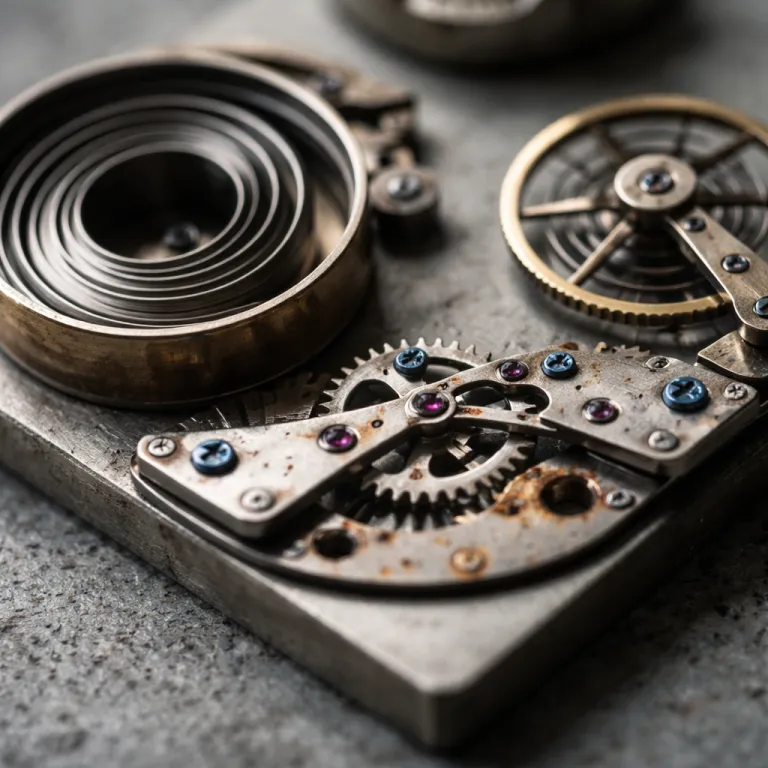
Mechanical watch movement explained through the four core organs
A serious mechanical watch starts with one thing; a mainspring coiled inside a barrel that stores energy like a compact steel battery. When you see a mechanical calibre diagram in a boutique brochure, what you are really looking at is how that mainspring, barrel and winding mechanism cooperate to deliver stable power over time. A good sales associate should be able to show you the crown wheel, explain how you wind the mainspring, and relate that directly to the stated power reserve on the spec sheet.
Think of the gear train as a disciplined relay team that passes energy from the barrel to the escapement with as little loss as possible. Each wheel and pinion pair in that train — centre wheel, third wheel, fourth wheel and escape wheel — divides rotation so that one full turn of the hour wheel equals twelve hours, while the minute wheel and cannon pinion translate that into the motion of the minute hand and second hand you read at a glance. When a salesperson walks you through a movement, ask how efficiently that gear train is cut and finished, because rough teeth or poor lubrication will bleed energy and shorten the effective power reserve.
The escapement is where the poetry starts; it chops continuous energy into precise beats. In most mechanical watches you will see a Swiss lever escapement, where a lever locks and unlocks the escape wheel against the impulses of the balance wheel, but you may also encounter detent or co-axial systems in higher end movements such as Omega’s Co-Axial calibres. Whatever the architecture, the escapement, balance and hairspring together decide how your watch keeps time, how it reacts to shocks, and how it behaves when left dial up on a nightstand versus crown down on a desk.
At the heart of this story sits the balance, a tiny wheel oscillating back and forth on a hairspring. A slower balance wheel at 21,600 vibrations per hour tends to offer a more relaxed gear train and potentially longer service intervals, while a faster one at 28,800 or even 36,000 vibrations per hour — as seen in high-beat movements like Zenith’s El Primero — can improve timekeeping stability at the cost of more wear on the escapement and train. When you compare movements, ask not only about accuracy in seconds per day but also about how the chosen beat rate, mainspring strength and overall movement architecture will age over ten or twenty years of real wrist time.
Mainspring, barrel and power reserve: what the spec sheet really means
Collectors often obsess over complications while ignoring the mainspring and barrel that quietly run the show. A 40 hour power reserve means the watch movement will run for roughly two days off the wrist, while a 70 hour reserve lets you take off an automatic watch on Friday night and still see the second hand sweeping on Monday morning. When you read marketing copy about an in-house calibre, translate it into a simple question; how efficiently does this movement turn stored energy into stable timekeeping without overstressing the spring or gear train.
Longer power reserves usually come from either a stronger mainspring, a larger barrel, or twin barrels in series, but each choice has trade-offs. A very strong spring can overload the gear train and escapement when fully wound, so good calibres manage torque with careful tooth profiles on each wheel and pinion, or by using slipping bridle systems in automatic winding to avoid overwinding when you wind the mainspring through daily wear. When you compare watches, look at whether the brand has simply stretched the mainspring for marketing numbers or genuinely re-engineered the movement to handle the extra power gracefully.
Manual winding versus automatic winding also changes how you experience that stored energy over time. A hand-wound mechanical watch makes you interact with the crown wheel and winding mechanism every morning, which lets you feel changes in resistance that might signal a dry barrel arbor or tired spring, while an automatic rotor hides that feedback but keeps the movement topped up as long as you stay active. If you mainly rotate several watches in a small collection, a longer power reserve in both manual and automatic movements becomes more than a spec; it is the difference between setting the time once a week or every single day.
Do not forget that quartz and quartz movement technology set a different baseline for power and convenience. A typical quartz watch uses a battery and an electronic oscillator instead of a mechanical mainspring and balance wheel, which means multi-year power with almost no interaction beyond changing the cell, but it also removes the tactile pleasure of feeling the crown engage the cannon pinion and minute wheel when you set time. For an aspiring collector, understanding how a traditional mechanical calibre differs from a quartz movement clarifies why you might accept a few seconds of drift per day in exchange for the living, breathing energy flow of springs, wheels and levers.
In the sports luxury segment, think about how a robust barrel and mainspring behave under real use, such as a yellow gold Yacht Master worn daily in an office and on weekends. When you read a detailed review of a modern nautical piece, such as an analysis of the allure of a yellow gold Yacht Master, pay attention to how the writer describes winding feel, crown engagement and power reserve stability over months of wear. Those details tell you far more about the underlying movement than any press release claim about extended autonomy or proprietary alloys.
Gear train, escapement and balance: where energy becomes time
Once the mainspring releases energy from the barrel, the gear train takes over as the translator between raw torque and readable time. Each wheel and pinion pair in that train — from the centre wheel through the third wheel and fourth wheel to the escape wheel — divides rotation into the precise ratios that drive the hour wheel, minute wheel and cannon pinion, which in turn carry the hour hand, minute hand and often the central second hand. When you study movement diagrams, trace how one full turn of the crown wheel during winding eventually becomes the smooth sweep or crisp tick you see on the dial.
The escapement sits at the end of the gear train and acts as a gatekeeper that meters energy into the balance wheel. In a Swiss lever escapement, the lever alternately locks and unlocks the escape wheel teeth, giving the balance tiny pushes that keep it oscillating while also allowing the train to advance in controlled steps, and this dance is what defines the beat you hear when you hold a mechanical watch to your ear. Alternative escapements like detent or co-axial systems change how the lever and escape wheel interact, often aiming to reduce friction and improve long term stability, but they still serve the same core purpose: turning continuous power into discrete, countable movements.
The balance and hairspring form the regulating organ that turns those impulses into consistent timekeeping. A well-poised balance wheel with a precisely formed hairspring will return to its centre position at the same rate regardless of amplitude, which is why a chronometer-rated movement can keep time within a few seconds per day across positions and temperatures, while a poorly adjusted one will drift as the watch rests crown up, crown down or dial up. When you evaluate claims from brands, ask how they adjust the balance in multiple positions, what beat rate they choose, and how that affects both accuracy and long term wear on the escapement and gear train.
Reading a movement through a sapphire back is a skill worth cultivating early in your collecting journey. Look for even Côtes de Genève on the bridges, clean perlage on the mainplate, and sharp anglage on the edges of the steel parts, but also pay attention to how the wheels, levers and springs actually interact when you gently wind the mainspring or set time with the crown. A thoughtful article on the artistry of a well executed calibre can train your eye to see beyond decoration and into the underlying logic of the watch movement itself.
Hands, setting and winding: how the interface reveals the mechanics
The way a watch lets you set time and wind the mainspring tells you a lot about the underlying movement. When you pull the crown to the first position and feel the cannon pinion and minute wheel engage, the smoothness or grittiness of that motion reflects how well the gear train and setting lever system are finished and lubricated. A precise, backlash-free motion of the minute hand and hour hand as you rotate the crown, with the second hand either hacking cleanly or continuing its sweep, is a practical lesson in movement quality you can feel with your fingertips.
Inside the movement, the key setting components form a compact but sophisticated mechanism. The hour wheel, minute wheel and cannon pinion sit at the centre of the dial side, meshing with the fourth wheel and sometimes an indirect seconds train, while a setting lever and yoke move a sliding pinion to switch between winding and hand setting modes as you pull the crown. When you wind the mainspring in the neutral position, the crown wheel and ratchet wheel transmit torque directly to the barrel, but when you set time the same rotation passes through the motion works to reposition the hands without disturbing the underlying escapement and balance wheel.
Automatic movements add another layer of complexity with their winding mechanism. A rotor swings with wrist motion and drives a reverser system that turns the crown wheel and ratchet wheel in the correct direction to wind the mainspring, often through a reduction gear train that optimises torque and efficiency, and this is why an automatic watch can maintain its power reserve as long as you wear it regularly. For collectors who rotate several mechanical watches and quartz pieces, understanding how quickly an automatic movement replenishes its energy and how the winding mechanism behaves on a winder can prevent both under-winding and unnecessary wear.
Even the humble quartz watch has a setting and display system that mirrors mechanical logic. A quartz movement still uses a gear train, cannon pinion, hour wheel and minute wheel to move the hands, but the driving force comes from a stepper motor controlled by an electronic oscillator rather than from a barrel and mainspring, which is why the second hand usually jumps in one second increments instead of sweeping. Comparing the tactile feel of setting a quartz watch to that of a finely made mechanical watch is a quick way to internalise how traditional watchmaking works in real, physical terms rather than abstract diagrams.
Reading value through the caseback: finishing, complications and long term wear
Turn a watch over and the caseback becomes your most honest sales associate. A well executed mechanical watch movement will show consistent finishing on bridges and plates, cleanly polished screw heads, and thoughtfully bevelled steel parts such as the lever, escape wheel bridge and balance cock, while a cheaper calibre may hide rough machining under a few token stripes. When you handle a watch in a boutique, ask the salesperson to point out the gear train, barrel, balance wheel and escapement so you can connect the visual layout to the performance claims.
Complications sit on top of these fundamentals, not instead of them. A perpetual calendar from a brand like Frédérique Constant or Oris matters because it brings serious calendar engineering — cams, levers and additional wheels layered onto the base movement — into a price range where aspiring collectors can actually buy, wear and service the watch over time. The same logic applies to high concept pieces from houses such as Patek Philippe or Audemars Piguet; their sunrise and sunset indications or anniversary calibres only impress when the underlying barrel, mainspring, gear train and escapement are robust enough to handle the extra load without compromising power reserve or reliability.
Vintage and pocket watches offer another angle on value and longevity. When you study the enduring charm of old silver pocket watches in a detailed guide, such as an article on the enduring charm of old silver pocket watches, you see how large barrels, slow beating balances and generously sized wheels can run accurately for generations with proper care. Comparing those older movements to modern slim automatic calibres, with their compact barrels and tightly packed gear trains, gives you a deeper perspective on why some watches age gracefully while others feel tired after a decade.
When you stand at a counter considering a mechanical watch versus a quartz alternative, ask three simple questions that cut through the marketing. How is the power reserve achieved and managed in this movement, what type of escapement and beat rate does it use, and how does the brand finish and adjust the gear train and balance across positions over the long term. The answers will tell you whether you are buying a piece of horological engineering that will still feel satisfying when you wind the mainspring and set time ten years from now, or just another shiny object that looks good in a press shot but dulls quickly on the wrist.
Key statistics on mechanical movements and performance
- Mechanical wristwatches typically offer a power reserve between 38 and 72 hours, with extended reserves above 70 hours often requiring redesigned barrels and mainsprings rather than simply stronger springs. Well known examples include Rolex’s 70 hour Calibre 3235 and Omega’s 60 hour Co-Axial 8800.
- Common beat rates for modern mechanical movements are 21,600, 28,800 and 36,000 vibrations per hour, and higher frequencies generally improve stability against shocks at the cost of increased wear on the escapement and gear train.
- Swiss chronometer certification (COSC) usually requires an average daily rate within −4 to +6 seconds per day across multiple positions and temperatures, which demands precise adjustment of the balance wheel and hairspring.
- Standard quartz movements typically achieve accuracy within about ±15 seconds per month, while high-accuracy quartz calibres can reach a few seconds per year, and both far surpass standard mechanical watches, but they rely on battery power rather than a mainspring and barrel.
- High end hand finished movements can require several times more labour hours than industrially finished calibres, largely due to manual anglage, black polishing and detailed decoration of wheels, levers and bridges.
Frequently asked questions about mechanical watch movements
What are the main parts of a mechanical watch movement?
A mechanical watch movement is built around four core organs: the mainspring and barrel that store energy, the gear train that transmits it, the escapement that meters it, and the balance wheel and hairspring that regulate timekeeping. Supporting systems include the winding mechanism, motion works for the hands, and any additional modules for complications such as calendars or chronographs. Understanding how these parts interact gives real meaning to traditional watchmaking beyond simple marketing language.
How does power reserve affect daily wear?
Power reserve describes how long a fully wound mainspring and barrel can keep the movement running before stopping. A shorter reserve around 40 hours usually means you must wear or wind the watch daily, while a longer reserve near 70 hours lets you take it off for a weekend without needing to reset time on Monday. For collectors rotating several watches, a longer power reserve reduces the hassle of frequent setting and can indicate a more efficient gear train and escapement design.
Why do some mechanical watches beat faster than others?
The beat rate, measured in vibrations per hour, reflects how quickly the balance wheel oscillates under the control of the escapement and hairspring. Higher rates such as 28,800 or 36,000 vibrations per hour can improve stability against shocks and positional changes, but they also increase wear on the escapement and gear train over time. Lower rates like 21,600 vibrations per hour may offer slightly less theoretical precision but can be gentler on components and contribute to a different visual character of the second hand sweep.
What is the practical difference between mechanical and quartz movements?
A mechanical movement uses a mainspring, barrel, gear train, escapement and balance wheel to keep time purely through mechanical energy, while a quartz movement relies on a battery powered electronic oscillator that drives a stepper motor and gear train. Quartz watches usually offer superior accuracy and longer intervals between services, but they lack the tactile engagement of winding the mainspring, setting time through the motion works, and watching a smooth mechanical second hand sweep. Many collectors choose mechanical watches precisely for this interaction and the visible craftsmanship of the movement under a sapphire caseback.
How can I quickly judge movement quality through a sapphire back?
When you look through a sapphire caseback, start by checking the overall cleanliness and consistency of finishing on bridges, plates and wheels. Even, well aligned Côtes de Genève, neat perlage, sharp anglage and properly polished screw heads suggest care, while rough machining, inconsistent decoration and visible burrs on levers or the escape wheel can signal cost cutting. Combine that visual inspection with how the watch feels when you wind the mainspring and set time, and you will have a practical, collector level assessment of movement quality in under a minute.