Summary
Analysis score
Average of the criteria rated below
Is the Complexity worth the money?
Loud, skeletonized, and built to make a statement
Size, strap, and day‑to‑day wear potential
Stainless steel, sapphire crystal, and a bold leather strap
Gift‑ready presentation and shipping experience
How tough is it likely to be over time?
Automatic movement, features, and real‑world expectations
What the Swan and Edgar Complexity actually offers
Pros
- Bold skeleton and moonface-style design that many buyers find visually appealing and gift‑worthy
- Stainless steel case with sapphire crystal and automatic movement at a fashion‑watch price point
- Long 5‑year manufacturer warranty adds reassurance versus many competitors
Cons
- Limited 30 m water resistance despite a confusing “swimming” tag, so it’s not suited for real water use
- Vague movement details and one reported case of poor build quality raise questions about consistency
- Loud gold/red styling and large strap width make it less versatile for everyday or conservative wear

Specifications
View full product page →| Brand | SWAN AND EDGAR |
A bold dress watch that wants to look high‑end
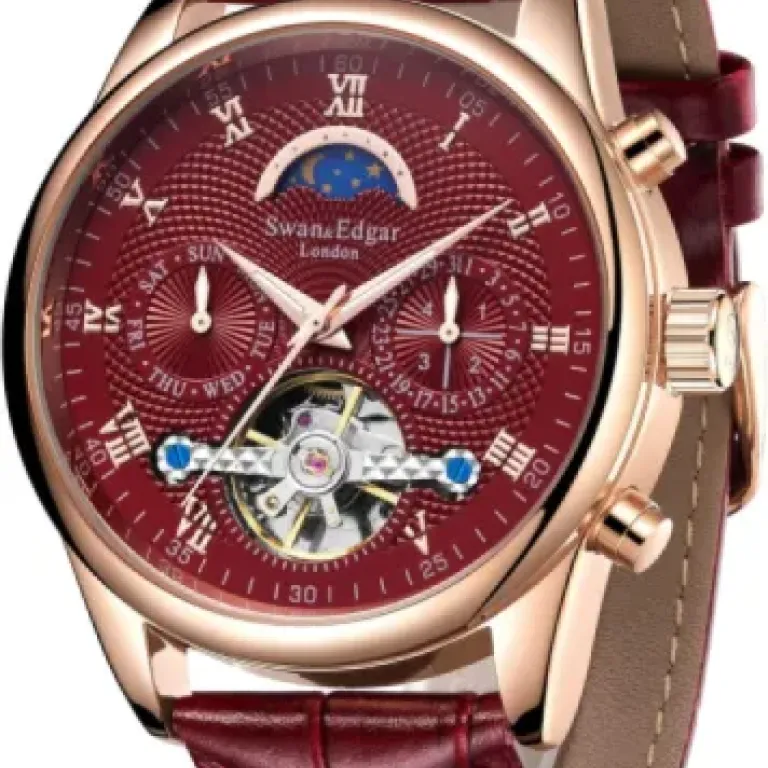
The Swan and Edgar "Complexity" Automatic is clearly aimed at people who want a visually busy, conversation‑starter watch without paying luxury‑brand prices. On paper, it ticks quite a few boxes that usually sit higher up the price ladder: automatic movement, moonphase-style day/night indicator, skeleton dial and display caseback, sapphire crystal, and a 5‑year manufacturer warranty. The model looked at here is the gold case with red dial and red leather strap, so this is not a low‑profile office piece; it’s a watch for someone who likes strong colours and noticeable wrist presence.
The watch sits in the fashion category rather than traditional Swiss horology. It’s assembled in China, uses an automatic movement with a stated 210 parts and 20 jewels, and pairs that with a 41 mm stainless steel case and 24 mm leather strap. That wide strap relative to the case size suggests a fairly chunky look on the wrist. At 0.36 kg packaged weight, it’s not a featherweight piece either, which fits the “statement” comments that appear in the reviews.
Public reviews give it an average of 4.2 out of 5 stars from around 79 ratings, so buyers are mostly satisfied, but not unanimously. Some reviews praise the look, perceived class, and gift appeal. Others raise concerns around build quality, with at least one verified buyer explicitly saying they returned it for that reason. That split is important: this watch seems to win people over on appearance and presence, while raising a few questions on long‑term robustness.
In my opinion, this is a watch to consider if you care more about visual impact and features on paper than about traditional watchmaking pedigree. The spec sheet is ambitious for the segment, and the long warranty is reassuring, but the mixed feedback on quality means it’s worth going in with realistic expectations: a bold fashion automatic with attractive specs, not a heirloom piece.
Is the Complexity worth the money?
The price is not displayed here, but given the brand positioning and specs, the Complexity sits in the affordable to mid‑affordable fashion automatic bracket. In that space, it competes with entry‑level Seiko 5s, Orient, and various microbrands and fashion labels. What it brings to the table is a very busy, decorative design, an automatic movement with visible internals, sapphire crystal (if the spec is accurate), and a 5‑year warranty, which is longer than what many competitors offer. The average Amazon rating of 4.2/5 from 79 reviews shows that most buyers feel they got decent value.
Where it lags behind some alternatives is brand heritage and technical transparency. You don’t get a named movement, clear accuracy specs, or detailed information on movement origin. Many traditional watch brands in a similar price range are more upfront about these details and offer simpler, more proven designs. On the other hand, those watches often look more conservative and may not offer the same level of dial “wow factor” if you specifically want a skeletonized, gold‑and‑red, moonface‑style piece.
Reviews repeatedly mention that it makes a good gift, looks good in person, and feels like good value. The main negative outlier is the comment about poor build quality and a return, which is a reminder that quality control might not be perfect. That’s fairly typical in this segment: you’re paying for looks and features first, and consistency second. The long warranty does help mitigate that risk, assuming the brand’s customer service is responsive.
In my opinion, the value proposition is strongest if you prioritize style and gift appeal. If you want a loud, dressy automatic that looks more expensive than it costs and you’re okay with the trade‑offs of a fashion‑oriented mechanical watch, it can be a reasonable buy. If you care more about movement pedigree, long‑term reliability, and understated design, there are more sensible choices from established watchmakers, even if they look less flashy on the wrist.
Loud, skeletonized, and built to make a statement
The design direction here is not subtle. The Complexity in gold/red is clearly for someone who wants their watch to be noticed. You get a red dial with multiple textures, an open‑heart or partial skeleton section showing the movement, and a day‑night indicator that acts like a decorative moonphase. That, combined with a gold‑tone case and a matching red leather strap, creates a very bold colour combination. Several Amazon comments back this up: one buyer says it “makes a statement,” another mentions being “absolutely obsessed” with how it looks, and a third calls it “classy” and a good-looking gift.
The dial layout is described as “spatial architecture,” which basically means a layered, multi‑level design. On paper, that usually gives depth and visual interest, but it can also hurt legibility if overdone. There’s no direct feedback in the reviews complaining about reading the time, so it’s likely acceptable for casual use, but this definitely leans more towards decorative complexity than minimalist clarity. If you prefer clean dials and slim, discreet cases, this design will probably feel too busy and loud.
The 41 mm case with a 24 mm strap suggests a watch that will feel quite broad on the wrist. That strap width is more common on larger cases, so visually the strap will look thick and substantial. The overall theme is “fashionable” and “sports/competition” per the spec sheet, but in reality it behaves more like a dress/fashion watch that happens to borrow a few sporty cues rather than something you’d seriously wear for athletic activity.
In my opinion, the design is the main selling point: it’s built to attract attention, work as a gift that looks more expensive than it is, and satisfy people who enjoy visible mechanics and a dramatic colour scheme. The downside is that it’s quite niche: if your style leans conservative or you want a versatile everyday watch, this combination of skeleton dial, gold plating and bright red strap is going to be hard to match with everything.

Size, strap, and day‑to‑day wear potential
Comfort is always a mix of size, weight, strap quality, and how you personally wear a watch. Here, the known figures are a 41 mm case diameter and a relatively wide 24 mm leather strap The strap is genuine leather with a hand‑waxed finish and a traditional tang buckle. Leather generally molds over time, which can improve comfort with regular wear. However, there are no detailed Amazon comments specifically about how it feels on the wrist, whether it breaks in nicely, or if there are issues like stiffness or irritation. The only comfort‑adjacent hints are positive: buyers describe it as “stylish” and “classy,” and one mentions that their partner loves the watch and its statement look, which indirectly suggests they’re happy wearing it. Water resistance is listed at 30 metres, which is basically splash protection. It’s fine for washing hands or getting caught in light rain, but not a watch to keep on in the pool or shower if you want the strap and seals to last. There is a confusing "sport type: swimming" tag in the specs, but in watch terms, 30 m does not qualify as suitable for swimming. From a comfort perspective, this means you’ll probably be taking it off for any real water activity, which is worth keeping in mind if you prefer a “wear it all day no matter what” piece. In my opinion, the Complexity is best suited as an occasion and office watch rather than a 24/7 daily driver. The leather strap, flashy design, and modest water resistance all point in that direction. If you’re comfortable with a larger, eye‑catching watch and don’t need it to handle sports or water exposure, it should work fine. If you want something you can forget on your wrist during workouts or swimming, or if you have a very small wrist, this probably isn’t the ideal choice.
Stainless steel, sapphire crystal, and a bold leather strap
On paper, the materials mix is one of the stronger aspects of the Complexity. The case is stainless steel with IP plating that’s advertised as nickel‑free and hypoallergenic. IP (ion plating) is a common method for colouring watch cases; it usually holds up better than basic paint, though it’s not immune to scratches or wear over time. For a gold‑coloured fashion watch, this is pretty standard, and the hypoallergenic claim is a plus for people with sensitive skin, at least in theory.
The spec sheet highlights a sapphire crystal, which is a genuine advantage versus the mineral glass used by many fashion brands in the same general price segment. Sapphire is significantly more scratch‑resistant in normal daily use. There is a confusing line in the description about “scratch resistant designer watch possess Mineral Glass,” which clashes with the separate “Crystal: Sapphire Crystal” spec. The most logical reading is sapphire on the front and mineral or standard glass elsewhere (for example on the caseback), but it’s not perfectly clarified. Even so, a sapphire front crystal alone is a solid practical benefit if you’re worried about scuffs on the dial window.
The strap is described as a hand-waxed red leather strap. Genuine leather is noted, which usually means mid‑range quality rather than top‑tier. The hand‑waxing is more of a finishing detail than a guarantee of durability, but it suggests an attempt to give the strap a richer appearance. There is no detailed feedback in the reviews focused on strap longevity, comfort, or wear, which typically means it’s at least acceptable for most buyers, since strap complaints tend to show up quickly when something is clearly bad.
One verified buyer does mention “bad build quality” and states they returned the watch instead of getting a replacement. That’s a single data point against many positive comments about appearance and perceived quality, so it’s hard to know if they encountered a rare defect or if there are broader consistency issues. In my opinion, the materials list looks good for a fashion automatic: steel case, sapphire crystal, and leather strap are all reasonable. The main question mark isn’t the ingredients themselves but the level of quality control in assembly and finishing, which no spec sheet can fully answer.
Gift‑ready presentation and shipping experience
While the exact box design isn’t spelled out, there are a few clues about how the Swan and Edgar Complexity is presented. The product is clearly positioned as an ideal gift for holidays, birthdays, anniversaries and other special occasions, which usually means the brand puts some effort into the unboxing experience. The package dimensions are listed as 20.3 x 12.5 x 10.1 cm with a total weight of about 360 g, which points to a standard watch presentation box rather than a minimal cardboard sleeve.
The included components mention a “belt” and “belt clip,” which is slightly odd wording in a watch context. It may be a translation or catalog issue and likely refers to the strap and buckle rather than extra accessories. There’s no sign of additional straps or tools. Among the Amazon comments, one reviewer specifically notes that it was “economically and sustainably packaged,” which suggests the external shipping packaging is not overly wasteful, and the product still arrived in good condition. Another reviewer mentions the watch arrived earlier than expected, which is more about logistics than packaging, but still relevant for gift planning.
Since this model is marketed heavily as a gift, the perceived quality of the box matters. Even without photos, it’s reasonable to expect a branded Swan & Edgar box, watch cushion, and some paperwork about the 5‑year warranty and basic instructions. Reviews don’t complain about damaged boxes or sloppy presentation, which tends to pop up quickly if it’s a common issue. Instead, several comments mention that recipients were pleased and that the watch was “appreciated” as a gift, which implies the overall presentation passes the eye test for most buyers.
In my opinion, the packaging is likely solid for the price segment: not luxury‑grade, but respectable enough to hand over as a present without feeling cheap. If you’re buying this mainly as a gift, you probably won’t need to re‑box it yourself, and the combination of bold watch design plus decent presentation should make a good first impression.

How tough is it likely to be over time?
Durability is where you have to look beyond the marketing buzzwords. On the positive side, the Complexity uses a stainless steel case and advertises a sapphire crystal on the front. Stainless steel is the standard for everyday watches and holds up well to bumps and general wear. Sapphire is highly scratch‑resistant in typical conditions, so the dial window should stay clear if the crystal spec is accurate. The IP plating is marketed as nickel‑free and hypoallergenic, and IP coatings usually last longer than cheap gold paint, though they can still show wear on edges and high‑contact points over time.
The water resistance is listed as 30 metres, which realistically means “keep it dry when you can.” It’s fine for occasional splashes but not something to expose to regular swimming, hot showers, or high moisture environments. There’s a bit of a mismatch here: the spec table tags “sport type: swimming,” but in watch standards, 30 m is not a swimming rating. If you treat it as a dress/fashion watch and avoid water, the seals and case should stay in decent shape longer.
In the reviews, the majority of comments around quality are positive or neutral: people call it “good quality,” “good value,” and mention that it arrived as described and made a nice gift. However, one verified buyer explicitly mentions bad build quality and returned the watch, which suggests quality control may not be perfect. That’s not surprising in this segment: fashion‑oriented automatics assembled in China often have some variability in finishing, alignment, or movement regulation. The 5‑year warranty is a notable counterbalance; it indicates the brand is at least willing to stand behind the product for a longer period than many low‑cost alternatives.
In my opinion, the Complexity should be treated as a careful‑use watch. The materials list is reassuring on paper, but the mix of an automatic movement, decorative complications, and modest water resistance means it will never be as tough as a simple quartz sports watch. Worn mainly for work, dinners, and events, and kept away from water and hard impacts, it should hold up reasonably. Used as a rough everyday beater, especially in wet or dusty environments, it’s likely to show its limits faster.
Automatic movement, features, and real‑world expectations
In terms of performance, the Complexity offers a mechanical automatic movement with 20 jewels and a claimed 210 parts. That sounds sophisticated, but there’s no mention of accuracy specs (like ± seconds per day) or power reserve, and no brand or calibre is named. So, you should treat it as a typical fashion‑segment automatic: it will likely keep time well enough for everyday use, but not with the precision of a regulated Swiss or Japanese movement from established manufacturers. Among the published reviews, there are no major complaints about timekeeping, which usually means it’s acceptable for the target audience.
The watch includes a day‑night (moon face) indicator, open‑heart dial, and a skeleton caseback. These are more about visual appeal than functional performance. A true moonphase complication tracks lunar cycles; a day‑night indicator simply rotates to show day or night. The spec wording blurs that line, but visually most buyers seem pleased, with comments highlighting how engaging the dial is and how much it gets noticed. If you’re into mechanical details and like to see moving parts, this watch should satisfy that itch, though you shouldn’t expect high‑end finishing under the loupe.
There is a “Clean Sweep design” listed under special features, which suggests the seconds hand may move more smoothly than a standard quartz tick. That fits the nature of automatic movements, which usually beat several times per second, creating a smoother visual motion. This is one of the tangible perks of mechanical watches for many people, even if it doesn’t actually improve functional performance.
Water resistance at 30 m is basic and should be treated as protection against splashes, not a license for swimming, despite the confusing sport tag. There’s also no mention of shock resistance, anti‑magnetic features, or hacking/hand‑winding capabilities, which you do see spelled out on more tool‑oriented watches. In my opinion, the Complexity’s performance is geared towards casual, mostly indoor use: it tells time reasonably, offers some visual mechanical interest, and that’s about it. If you want bulletproof accuracy, ruggedness, or clear technical specs, this isn’t the model for you.

What the Swan and Edgar Complexity actually offers
The Complexity Automatic positions itself as a dressy fashion watch with mechanical credentials. It uses an automatic movement powered by wrist motion, so there’s no battery; instead, the rotor inside winds the mainspring as you move. The brand highlights a 210‑part, 20‑jewel movement, which sounds impressive, but there’s no mention of the origin or specific calibre, so it’s reasonable to assume a generic automatic rather than a high‑end Swiss engine. Still, for someone moving up from quartz fashion watches, having a mechanical movement with visible internals can feel like a step into “real” watch territory.
The case is 41 mm in diameter with a round shape and stainless steel construction, finished in a gold‑tone plating that the brand says is nickel‑free and hypoallergenic. On top, you get a sapphire crystal, which, at least on paper, is a solid point for scratch resistance in this price band. There’s also mention of mineral glass in the marketing text, which is a bit confusing: it likely means sapphire on the front and mineral or standard glass elsewhere, but it’s not perfectly clear. Either way, sapphire on the main dial side is a tangible plus compared with many fashion watches that stick to mineral only.
The dial is where the “Complexity” name comes from: you get a skeleton/open‑heart layout, a day/night indicator that the brand calls a moon face, and various textures over a red base. The back of the case is also see‑through, with the Swan & Edgar logo and a skeleton caseback that lets you see the movement. Water resistance is listed at 30 metres, which in watch‑speak means splash‑proof and okay for accidental contact with water, but not a watch you should deliberately take swimming or showering despite the “sport type: swimming” line in the spec table.
Finally, the watch comes on a hand-waxed red leather strap with a tang buckle, and the package apparently includes some form of “belt” or belt clip, though that wording is vague. The standout promises are the 5‑year manufacturer warranty and a visual package that’s heavily styled. In my opinion, the overall presentation is that of a feature‑packed fashion automatic aimed at gifting and special occasions rather than a tool watch or daily beater.
Pros
- Bold skeleton and moonface-style design that many buyers find visually appealing and gift‑worthy
- Stainless steel case with sapphire crystal and automatic movement at a fashion‑watch price point
- Long 5‑year manufacturer warranty adds reassurance versus many competitors
Cons
- Limited 30 m water resistance despite a confusing “swimming” tag, so it’s not suited for real water use
- Vague movement details and one reported case of poor build quality raise questions about consistency
- Loud gold/red styling and large strap width make it less versatile for everyday or conservative wear
Conclusion
Analysis score
The Swan and Edgar Complexity Automatic in gold and red is a watch for people who want impact first and foremost. It offers a visually busy skeleton/open‑heart dial, a day‑night indicator, a gold‑tone case, and a bright red leather strap. On paper, the ingredients are attractive for the segment: stainless steel case, sapphire crystal, automatic movement with visible mechanics, and a generous 5‑year warranty. Public reviews are mostly positive, with many buyers praising the appearance, gift suitability, and perceived quality, which lines up with the brand’s fashion‑forward positioning.
It’s not without caveats. Water resistance is only 30 m, so it should be treated as a dress/fashion watch, not a swim companion, despite the confusing “sport type: swimming” tag. Technical details on the movement are vague, and at least one buyer reports disappointing build quality and a return, hinting that quality control may be uneven. Compared with simpler automatics from traditional brands, you’re clearly paying more for design than for horological pedigree.
In my opinion, this watch makes the most sense for someone who wants a bold, gift‑ready automatic that looks high‑impact on the wrist and doesn’t mind treating it with some care. It’s a decent deal if you value style, visible mechanics, and a long warranty over technical transparency and ruggedness. If you’re a movement geek, a daily sports‑watch wearer, or you prefer understated pieces, you’re better off looking at more conservative offerings from established watch brands.


