
Summary
Editor's rating
Is it worth the price compared to other winders?
Looks and finish: nicer than “cheap Amazon box”, but not luxury
Power options: USB‑C is handy, but the adapter situation is annoying
Build quality and materials: solid enough, with a few budget touches
How sturdy it feels and how it might age
Daily use, noise level, and how well it keeps watches running
What you actually get and how it’s set up
Pros
- Keeps two automatic watches running reliably with simple, effective rotation modes
- Looks nicer than many budget winders thanks to the red piano-style finish and slanted design
- Quiet motor suitable for bedroom or office use, with handy auto-stop lid sensor
Cons
- No power adapter included despite AC power being advertised, so you need your own USB plug
- Materials are clearly budget (MDF body, plastic lid) and glossy finish shows dust and fingerprints

Specifications
View full product page →| Brand | ANWBROAD |
A budget watch winder that actually looks decent on a shelf
I’ve been using the ANWBROAD JWW001Y watch winder for a little over two weeks with two automatic watches: a mid-range diver and a dress watch. I bought it mainly because I was tired of resetting the date and time every time I rotated between watches. I wasn’t expecting miracles at this price, more something that just keeps the watches running and doesn’t look too cheap on the dresser.
Right out of the box, my first reaction was basically: “okay, this looks nicer than I thought.” The red piano-style finish doesn’t scream luxury, but it doesn’t look like a plastic toy either. It has a bit of weight to it (around 1.5 kg), so it doesn’t slide around when you open and close the lid. I set it up in my bedroom on a chest of drawers and plugged it in via USB-C to a spare adapter I already had.
Over these two weeks, I’ve mainly used Mode 4 and Mode 5, since they alternate directions and have pauses, which is usually what watch brands recommend. Both of my watches stayed fully wound, no time loss, no weird behavior. The blue LED light turns on with the motor and gives that typical “watch display” vibe. Personally, I would have preferred a switch to turn the light off, but it’s not a huge problem.
Overall, my first impression is that it’s a pretty solid budget winder: it looks okay, it does the job, and the motor noise is low enough that I can sleep with it running nearby. It’s not perfect – the missing power adapter in the box is annoying, and the pillows are a bit bulky for very small wrists – but for the price bracket it sits in, it feels like decent value rather than a gimmick.
Is it worth the price compared to other winders?
In terms of value for money, this ANWBROAD sits in a fairly crowded space: budget to mid‑range dual watch winders. You can find cheaper plastic boxes that do the bare minimum, and you can find much more expensive branded winders that cost several times more. This one falls in that middle zone where you’re paying a bit for looks and a bit for features, but not going crazy.
What you get for the price:
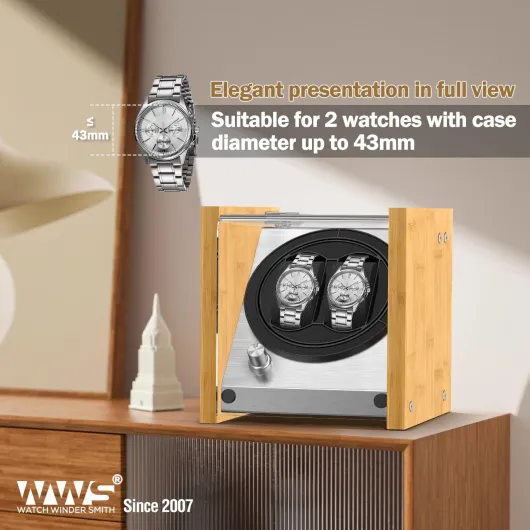
- Space for 2 watches
- Multiple rotation modes (both directions + rest cycles)
- USB‑C power and battery option
- Auto‑stop lid sensor
- Blue LED lighting
- A box that actually looks presentable
On the downside, there are some cost-cutting choices: no power adapter in the box, plastic lid instead of glass, MDF instead of real wood, and no advanced controls for exact turns‑per‑day. If you’re picky about specs or you own high-end pieces and want a winder from a known luxury brand, you’ll probably want to spend more and get something with more precise control and maybe better long-term support.
From my point of view, for a casual collector or someone with two daily automatics, this is good value. It’s not dirt cheap, but it looks nicer than many similarly priced options and does the main job reliably. If you can live with buying your own power adapter and you don’t need anything fancy, it’s a sensible compromise between price and features. If you’re very budget-focused and don’t care about looks, you can probably find a simpler, cheaper unit. If you’re chasing premium feel and brand prestige, you’ll need to look higher up the ladder.
Looks and finish: nicer than “cheap Amazon box”, but not luxury
Visually, the red wooden piano finish is the main selling point. In person, it looks better than standard black plastic boxes in this price range. The lacquered surface has a bit of shine, the wood grain effect is clearly fake but not offensive, and from a normal viewing distance it does give the impression of a more expensive piece. If you put it next to a high-end watch box, you’ll see the difference, but on its own on a dresser or in an office, it looks fine.
The box shape is a simple cube with a clear lid. The lid opens smoothly enough, but the hinge doesn’t feel premium – more like “decent for the price.” It stays open without slamming down, which is important when you’re putting watches in or out. The transparent window lets you see the watches even when it’s closed, which is nice if you like to see your collection instead of hiding it away. The slanted design is subtle but useful: the watches are slightly angled towards you, so you don’t have to stand directly above the box to see them.
One thing I noticed: the glossy finish picks up dust and fingerprints quite easily. If you’re picky about how your stuff looks, expect to wipe it down now and then. It’s not a big deal, just something to know. The interior is basic black, which is neutral and doesn’t clash with most strap colors or dials. No fake carbon fiber, no weird patterns – just simple.
Overall, the design is clean and fairly discreet. It doesn’t scream luxury, but it also doesn’t shout “budget plastic.” If you like shiny wood‑style boxes and want something that won’t look out of place in a bedroom or home office, it does the job. If you’re expecting the same level of finishing as a high-end watch brand display, you’re going to be disappointed, but at this price that would be unrealistic.
Power options: USB‑C is handy, but the adapter situation is annoying
Power-wise, the winder gives you two options: USB‑C (via an adapter) or 2 x AA batteries. I only used it on USB‑C, because I don’t feel like burning through AA batteries for something that runs every day. The good news is that USB‑C is pretty universal now, so you can use almost any phone charger brick you have lying around. I plugged mine into a 5V/1A adapter and it worked without any problem. Once connected, you basically forget about it.
The annoying part is that the power adapter is not included, even though the product description gives the impression that AC power is part of the deal. You do get the USB‑C cable, but no plug. For me it wasn’t a big issue because I have multiple spare adapters. But if someone buys this expecting a full ready‑to‑go AC setup and doesn’t have any spare adapters, that’s extra hassle and a few more pounds or euros to spend. That’s the kind of small detail that leaves a bit of a cheap impression.
I briefly tested it with AA batteries just to see if it worked. It does run, but honestly, I wouldn’t use it like that long term. Watch winders are designed to run for hours and days, and AA batteries are going to drain faster than you think, especially on the more active modes. I see the battery option more as a temporary solution if you want to place it somewhere without an outlet or maybe for short-term display.
So in practice, USB‑C power is the way to go, and it’s nice that you’re not stuck with a proprietary connector. But the lack of included adapter is a clear downside. For a slightly higher price, including a basic adapter would have made the experience smoother and avoided some of the frustration that shows up in the reviews.
Build quality and materials: solid enough, with a few budget touches
Material-wise, this is mostly MDF or similar wood composite with a lacquered finish. So it’s not actual solid hardwood, but that’s standard for this price. The weight (around 1.48 kg) gives it a bit of a sturdy feel – it doesn’t feel hollow or flimsy. When you tap the sides, you get a solid knock, not that thin plastic sound. That gives a bit of confidence that it’ll hold up to daily opening and closing without falling apart quickly.
The inside is lined with a soft material (synthetic, obviously) that protects the casebacks and bracelets from scratches. It’s nothing luxurious, but it’s smooth and does what it needs to do. The watch pillows themselves are covered in the same kind of material. They’re firm but have a bit of give, so the watch doesn’t wobble around. The removable ring system is actually useful: you can remove the outer ring for smaller wrists or keep it on for larger bracelets. I tested it with wrist sizes around 17 cm and 19 cm, both fit fine, though very small wrists might still find the pillow a bit too big.
The clear lid is plastic, not glass. You can tell by the feel and the way it reflects light. It’s clear enough to see the watches properly, but it will probably scratch more easily than glass over time if you’re careless. The hinge mechanism is basic metal. It doesn’t feel like it’s going to break right away, but again, it has that “budget but acceptable” feel. The rubber feet under the box help it stay in place and also cut some vibration, which is good.
In short, materials are what you’d expect for the price: decent, functional, and not overly cheap, but clearly not premium. If you want a tank-like winder with real wood and glass, you’ll have to pay a lot more. For a mid‑range Amazon purchase, this sits in that middle ground where it feels okay in the hand and doesn’t look tacky on the shelf.
How sturdy it feels and how it might age
After a couple of weeks, obviously I can’t say how this thing will look in five years, but I can at least talk about how solid it feels and what seems likely to wear out first. The box itself feels rigid, no creaking, no flex when you pick it up from one side. The lid opens and closes consistently and doesn’t feel like it’s going to fall off. That said, the hinge and the lid material are clearly budget parts, so I wouldn’t slam it shut or force it too far back.
The lacquered finish looks good now, but it will need a bit of care. Because it’s glossy, dust, fingerprints, and minor scratches will show. If you wipe it gently with a microfiber cloth, it cleans up fine. If you drag keys or metal objects across it, you’ll probably mark it. The corners and edges seem properly finished, no peeling or rough patches on my unit, so that’s reassuring.
The motor is the main unknown on durability. It’s quiet and smooth at the moment, and other buyers mention using it for over a year and a half without motor failure, which is encouraging. There’s no obvious play or wobble in the rotation holders. When it runs, there’s no rattling or grinding noise, which usually signals cheap or badly mounted parts. So far, so good. Still, this is a budget winder, so I’d be realistic: it’s not built like an industrial device. If it gives you a few solid years, that’s already decent for the price.
The internal pillows compress slightly with use, but that’s normal. I don’t see them tearing quickly unless you force oversized bracelets on them. The anti-magnetic claim is hard to verify by hand, but at least I haven’t noticed any weird magnetization or timekeeping issues on my watches during this test period. Overall, durability seems acceptable for home use: treat it reasonably well, don’t drop it, don’t slam the lid, and it should hold up. If you’re expecting something that feels bulletproof, this isn’t it, but it doesn’t feel fragile either.
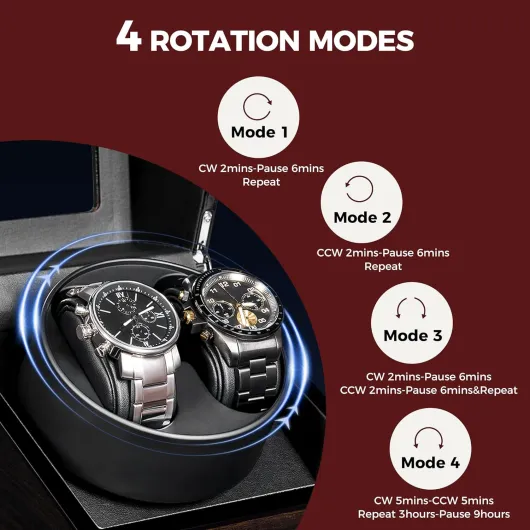
Daily use, noise level, and how well it keeps watches running
This is the part that matters: does it actually keep the watches wound and can you live with it running nearby. Over a bit more than two weeks, I kept two automatics in there almost full-time and switched between Mode 4 and Mode 5. Both watches stayed on time, with no noticeable gain or loss beyond their usual daily variation. No sudden stops, no weird behavior with the date change, nothing odd. So from a pure function point of view, it gets the job done.
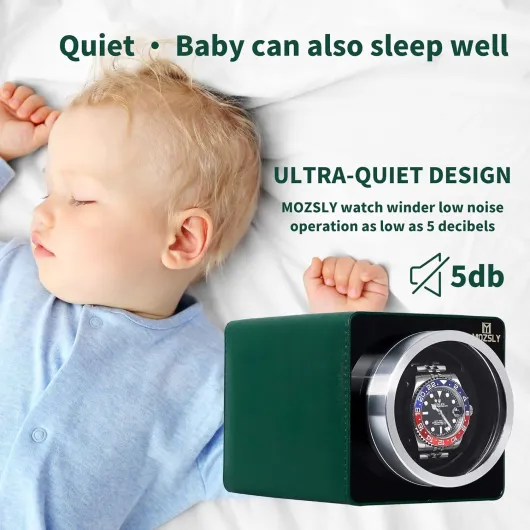
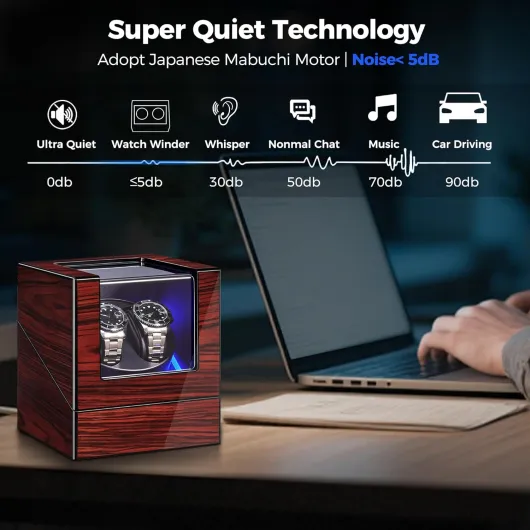
The noise level is honestly pretty low. The brand claims around 5 dB – I can’t measure that exactly, but in practice, on a dresser about two meters from my bed, I could barely hear it at night. If the room is totally silent and you focus on it, you hear a very soft motor hum when it’s moving, but it’s not annoying. One of the Amazon reviewers said they found it a bit louder than expected; for me it was fine, but if you’re ultra sensitive to noise, maybe don’t put it right next to your head.
The rotation modes are basic but cover most needs:
- Mode 2: clockwise 2 min, 6 min rest
- Mode 3: counter‑clockwise 2 min, 6 min rest
- Mode 4: alternating directions with rests
- Mode 5: 3 hours alternating, then 9 hours off
The auto‑stop lid sensor is a nice touch in daily use. When you open the lid, it pauses immediately, so you’re not trying to grab a moving watch. Close it, and it picks up the cycle again. Simple but practical. Overall, in terms of raw performance, it’s not fancy, but it’s reliable so far. Obviously I can’t judge long‑term motor durability after only a couple of weeks, but other users mention using it for over a year without motor issues, which is a good sign.
What you actually get and how it’s set up
In the box, you basically get the winder, two watch pillows, a USB-C cable, and a basic instruction sheet. That’s it. No power adapter, which is the first thing that bugged me. The listing talks about AC power and a Type‑C adapter, so you might expect a proper plug. In reality, you need to use your own USB adapter (phone charger style) or run it on two AA batteries, which are also not included. So if you don’t already have a spare adapter lying around, add that to the cost.
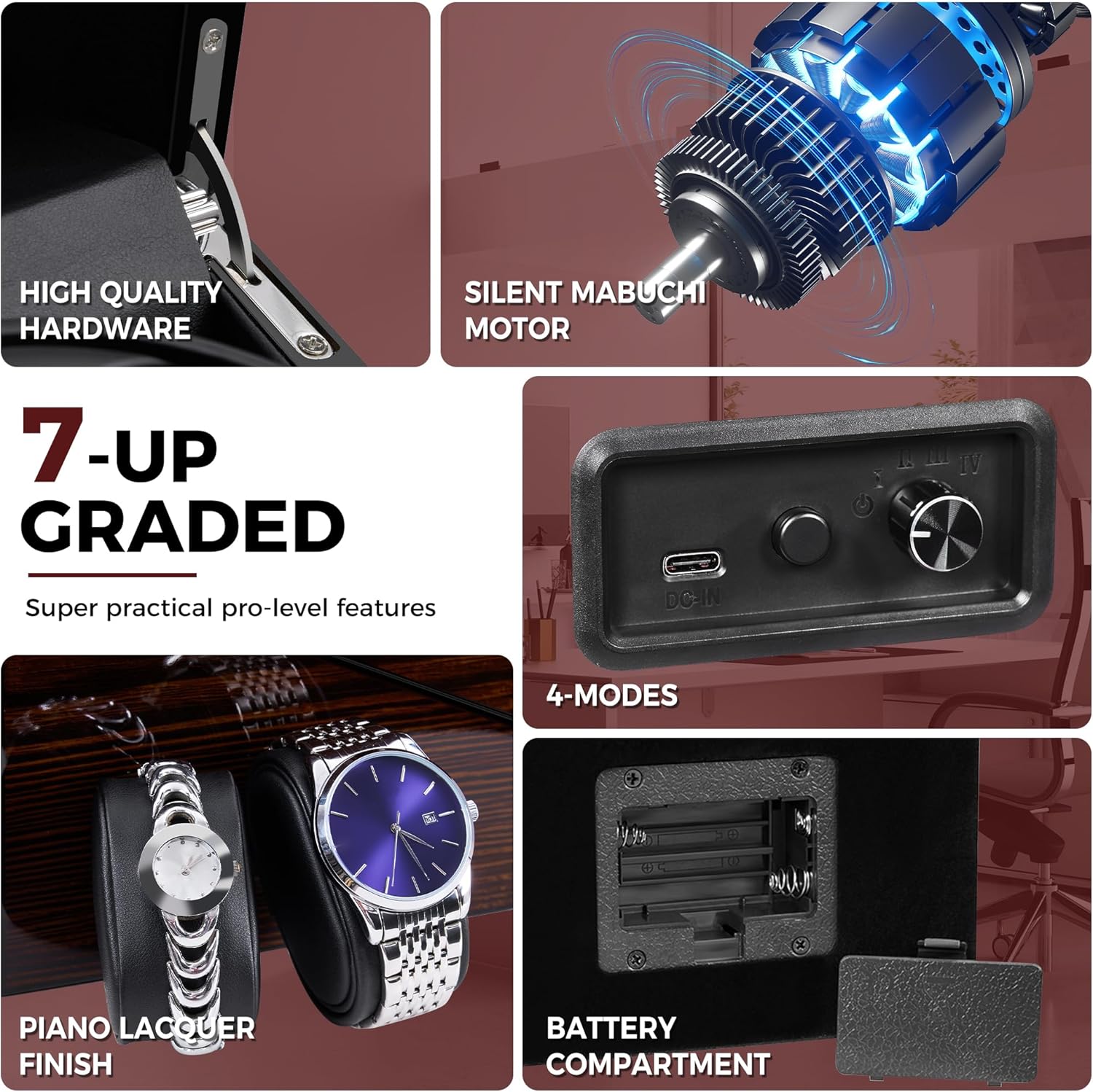
Setup is straightforward. On the back you’ve got the USB-C port, the battery compartment, and the rotation mode selector. There’s no app or fancy interface, just a little dial with the different modes printed in the manual. You plug it in, put your watches on the pillows, close the lid, and it starts according to the mode you selected. The auto-stop lid sensor works: when you open the lid, the rotation stops immediately, and it starts again when you close it. That’s handy if you don’t want to chase a moving watch when you’re trying to take it out.
The inside is pretty simple: black interior, two slots, blue LED strip lighting the watches when the motor is running. It’s not a luxury jewelry-store display, but it looks clean and doesn’t feel tacky. The whole unit is small enough (about 15 x 15 x 17 cm) to fit on a bedside table or a shelf without taking over the space. The angle is slightly slanted, so the watches face you instead of pointing straight up, which actually makes it easier to see them at a glance.
Functionally, there’s nothing complicated here. Five modes, clockwise and counter‑clockwise variations, and mixed cycles with rest periods. For someone who just wants plug‑and‑play, it’s easy enough. If you like to tweak exact turns‑per‑day numbers, this isn’t that precise, but for regular use it’s fine. In short: simple product, no real learning curve, but don’t expect any fancy features beyond the basics.
Pros
- Keeps two automatic watches running reliably with simple, effective rotation modes
- Looks nicer than many budget winders thanks to the red piano-style finish and slanted design
- Quiet motor suitable for bedroom or office use, with handy auto-stop lid sensor
Cons
- No power adapter included despite AC power being advertised, so you need your own USB plug
- Materials are clearly budget (MDF body, plastic lid) and glossy finish shows dust and fingerprints
Conclusion
Editor's rating
For what it costs, the ANWBROAD JWW001Y is a pretty solid dual watch winder that mainly stands out by looking better than most cheap options. It keeps two automatic watches running without fuss, offers a few useful rotation modes, and the motor is quiet enough to live in a bedroom without driving you crazy. The red piano-style finish and slanted design help it pass as a more expensive piece than it really is, as long as you don’t inspect it from two centimeters away expecting luxury‑brand quality.
It’s not free of drawbacks. The lack of a power adapter in the box is annoying and feels a bit stingy. The materials are clearly budget (MDF, plastic lid), and the finish will show dust and fingerprints. It also doesn’t offer super precise turns‑per‑day settings, so if you’re obsessive about that, this may feel too basic. But in daily use, it just works: you put your watches in, pick a sensible mode, and they stay wound. Simple as that.
I’d say this is well suited for casual enthusiasts with one or two automatics who want a decent-looking winder that doesn’t sound like a tractor. It also works as a gift, provided the person already has a spare USB adapter. If you have a large collection, own very high-end pieces, or want something with premium materials and brand cachet, you’ll probably want to spend more on a higher-tier winder. For everyone else, this is a practical, no‑nonsense option that offers good value without trying to be something it’s not.