
Summary
Editor's rating
Value for money: is it worth paying more than the cheap plastic ones?
Design: looks good on a shelf, with a couple of quirks
Power options and real-life usage (mains vs batteries)
Materials and build: more solid than the usual plastic boxes
Build quality and long-term feel
Performance and noise: does it actually keep the watches running?
What you actually get out of the box
Pros
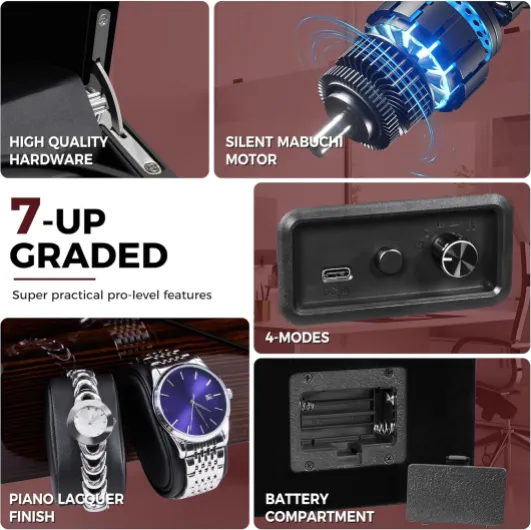
- Very quiet Japanese Mabuchi motor, suitable for living room or office use
- Bamboo wood housing and glass front look and feel more solid than cheap plastic winders
- Independent controls and multiple rotation modes for each of the two watches
Cons
- Supplied memory foam cushions deform and can let the watch move or touch the lid
- Blue LED light during rotation feels unnecessary and can be annoying in dark rooms

Specifications
View full product page →| Brand | Watch Winder Smith |
A watch winder that doesn’t feel like a plastic gadget
I’ve been using this Watch Winder Smith bamboo double winder for a bit now, mainly for two automatic watches that I rotate during the week. Before this, I had a cheap plastic winder from eBay that sounded like an old fan and looked pretty tacky on the shelf. So I was really looking for something that both works properly and doesn’t look out of place in a living room or office.
First impression when I unboxed it: this actually feels like a real object, not a toy. It’s fairly heavy (around 2.5 kg with the packaging), the bamboo casing looks clean, and the front glass is thick enough to feel solid. It doesn’t scream luxury, but it definitely doesn’t look cheap either. It’s closer to a small piece of furniture than a gadget, which I liked right away.
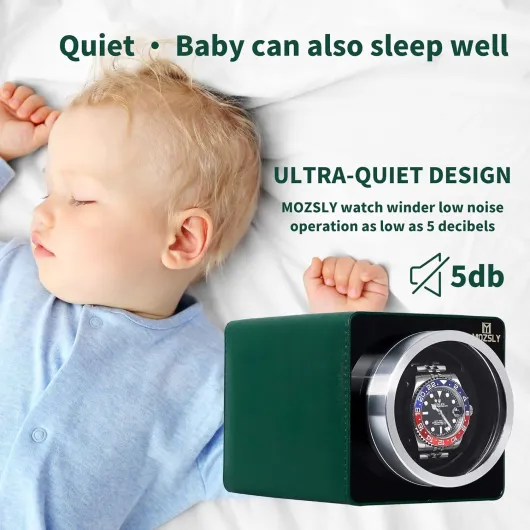
In daily use, the big thing I noticed is how quiet it is. My old winder had that constant buzzing that you notice as soon as the room gets quiet. With this one, you actually have to get close and listen for it. The Japanese Mabuchi motor claim doesn’t feel like marketing fluff; in practice, noise just isn’t an issue. I wouldn’t put it right next to my pillow, but on a dresser or desk it’s basically a non-problem.
Overall, my first takeaway after a few days was: it does the basic job well. It keeps the watches running, looks decent, and doesn’t annoy me with noise. It’s not perfect, and there are a couple of design choices I’d change, but for the price range it sits in, it feels like a pretty solid option rather than another disposable gadget.
Value for money: is it worth paying more than the cheap plastic ones?
Price-wise, this sits in that middle zone: more expensive than the ultra-cheap plastic winders, but way cheaper than the high-end watch boutique models. For what you get—bamboo casing, quiet Japanese motor, dual slots, independent controls—I’d say the value is pretty good. You’re paying a bit extra for something that actually looks decent on a shelf and doesn’t sound like a blender, and in my opinion that’s worth it if you own a couple of automatic watches you care about.
Compared to the bargain-basement units I’ve tried before, the biggest differences are the noise level and the overall feel. The cheap ones usually have loud motors, flimsy plastic boxes, and very basic controls. They technically work, but they look and sound cheap. This one feels more like a proper object. On the flip side, it’s still not on the same level as the really premium watch winders that cost several times more, with fancy finishes and ultra-precise programming. But honestly, for most people with a small watch collection, those high-end models are overkill.
The main thing that hurts the value slightly is the poor quality cushions. It’s not a deal-breaker because you can work around it easily, but it’s a weird corner to cut when the rest of the product is well thought out. Also, that blue light feels unnecessary and a bit cheap, which goes against the otherwise clean look. If they fixed those two details, this would be a very strong mid-range option.
As it stands, I’d say it’s good value for money if you want a quiet, decent-looking double winder and don’t mind swapping the cushions. If you just want the absolute cheapest way to keep a single watch running and don’t care about noise or looks, you can find less expensive options. But if your watches are worth a bit and you like having them on display, this hits a pretty sensible balance between price, function, and appearance.
Design: looks good on a shelf, with a couple of quirks
The overall design is pretty straightforward: a rectangular bamboo box with a glass front, magnetic closure, and two watch cups inside. From a distance, it looks like a small wooden display case, which is exactly what I wanted. It doesn’t scream “gadget” and doesn’t have that glossy plastic look you see on cheaper winders. If you’ve got wooden furniture, it blends in quite nicely. The bamboo has a uniform yellowish tone, and while it’s not luxury-level finish, it’s clean and consistent.
On the front, the two round dials for the winding modes give it a slightly retro vibe. They’re not just for show; they feel solid and click into position with a reassuring notch. This might sound like a small detail, but on day-to-day use it really matters. You’re not guessing whether the thing is actually set correctly. Each dial controls one cup, so you can run different programs on each side. That’s handy if one of your watches is more sensitive or needs fewer turns.
The glass window is large enough that you can see both watches clearly when they’re at rest and when they’re spinning. So as a display piece, it does its job. The magnetic clasp keeps the lid nicely shut, and opening/closing feels clean, not wobbly. No rattles, no weird misalignment. The only design choice I’m not a fan of is the internal blue light that some users mentioned. When the watches rotate, this light comes on and gives everything a kind of cheap “gadget” vibe. In daylight you barely notice it, but in the evening or in a bedroom it’s pretty visible. I’d rather have no light at all.
In terms of footprint, it’s not tiny but not huge either. It fits easily on a dresser or in a wardrobe shelf. The weight gives it a solid base so it doesn’t move around when the motor runs. For what it is, I’d say the design is practical and good-looking, with just that one slightly tacky blue light as the main misstep. If you want something that looks like a decent wooden box rather than a plastic spaceship, this works.
Power options and real-life usage (mains vs batteries)
This winder can run on both the included AC adapter and batteries, which is a nice bit of flexibility. I mainly used it plugged into the mains, because that’s the easiest and most reliable option if the winder sits in one place. With the adapter, you just set your modes once and forget about it. Over a couple of weeks, I had zero issues: no random stops, no strange resets, nothing. It just did its cycles as expected.
I also tested it briefly on batteries to see how practical that is. It runs, no problem, and it’s useful if you want to hide cables in a display cabinet or put the winder somewhere without an outlet nearby. That said, if you plan to use it only on batteries long-term, be prepared to change them from time to time. The brand doesn’t give a super precise battery life figure, and I didn’t run it long enough on batteries to drain them completely, but for daily use with two watches, I’d personally stick to the power adapter and treat batteries as a backup option.
The good thing is you’re not stuck with one solution. If you hate having cables on your dresser, you can go battery-only for a cleaner look. If you want to set-and-forget and never think about power, just plug it in and ignore the battery slot. The motor doesn’t seem to care which source you’re using; performance and noise were basically the same in both cases.
So in practice: mains power for everyday, batteries as a convenience. It’s not a portable device you’ll be moving around constantly, but the dual power option is handy if you change furniture or decide to move it into a cabinet or safe where a power outlet isn’t easily accessible.
Materials and build: more solid than the usual plastic boxes
The big selling point here is the 100% bamboo wood housing. Obviously, it’s not a solid hardwood collector’s chest, but compared to the plastic or fake wood wrap you get on a lot of cheaper winders, this feels much more serious. The bamboo panels are thick enough to give the box some weight and rigidity. When you tap on the sides, it sounds solid, not hollow. The grain is visible and the finish is smooth, with no sharp edges or rough spots on the parts you touch regularly.
The front window is glass, not plastic, which is good. It’s clear, doesn’t flex, and doesn’t feel like it’s going to scratch just from basic cleaning. The hinges and magnetic clasp do their job without feeling flimsy. You don’t get that “this will snap in six months” vibe when you open and close it daily. Inside, the cups and inner parts use a mix of plastic and metal. They’re not luxury, but they’re decent and don’t feel like they’re going to crumble. Given the price range, I think the balance between real wood and functional plastic is fair.
Now, the weak point for me is the supplied cushions. They’re made from a kind of memory foam that’s supposed to mold to your watch over 24 hours. In theory, that sounds clever. In practice, what happened (and what another user review also mentioned) is that after the foam compresses and takes shape, it no longer fits the cup properly. The cushion becomes slightly smaller, so the whole watch+cushion can wobble in the cup. When the winder rotates, the watch can slip and move toward the front and risk touching the glass. That’s obviously not great if you care about your bezels and crystals.
The workaround is simple: just use the cushion that came with your watch or another firmer cushion that fits the cup. Once I did that, the issue basically disappeared. But for a product that is otherwise well thought-out, the choice of this memory foam was a bit of a letdown. So, materials overall: outer box and mechanism feel solid and durable, but the stock cushions are a weak link and you’ll probably end up swapping them if you’re picky about your watches.
Build quality and long-term feel
Durability is always a bit tricky to judge without using the product for a full year, but there are some signs you can pick up early. After some regular use, the bamboo casing still feels solid, no warping or weird creaks. The lid lines up properly when closed, and the hinges haven’t loosened. The magnetic clasp still snaps shut firmly. So from a structural point of view, it feels like it will hold up fine with normal use.
The motor is another key point. The brand mentions they’ve been making winders since 2007 and use a Japanese Mabuchi motor. That doesn’t guarantee anything, but it’s better than a random unbranded motor. In actual use, the motor has been consistent: no grinding noises, no hesitation, no random stops. The rotation is smooth every time. Many cheap winders start off okay and then develop noise or stutter after a few weeks; this one hasn’t shown that behavior so far.
Inside, the cups and inner parts haven’t shown obvious wear either. The only thing that feels like it will age badly is those memory foam cushions. Even in a short period, you can feel them deform and not bounce back fully. That won’t break the winder, but it might annoy you enough to replace them. Luckily, that’s an easy fix with aftermarket cushions or the ones that came with your watches.
Given the materials (bamboo, glass, metal components) and the overall assembly quality, I don’t get the feeling that this is going to fall apart in six months. It’s still an item made in China at a mid-range price, so I’m not expecting tank-level durability, but for home use with two watches, it feels reliable. If you’re gentle with your stuff and don’t slam the lid or move it around constantly, it should last several years without drama.
Performance and noise: does it actually keep the watches running?
On the performance side, the question is simple: does it keep your automatic watches wound without overdoing it or making a racket? In my case, yes, it does. I ran two automatics on it: one everyday watch and one dress watch that I only wear a couple of times a week. Using the independent controls, I set slightly different programs for each side, and both stayed on time without needing manual winding or constant date resets.
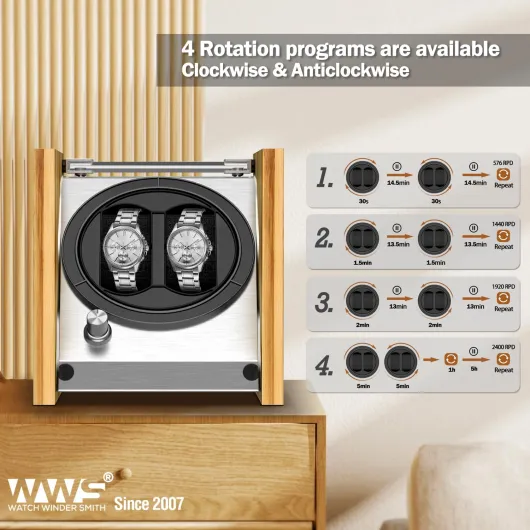
The rotation options cover clockwise, counter-clockwise, and alternating modes, with different turn-per-day cycles. That’s handy if you have watches from different brands, because they don’t all like the same winding direction or intensity. You don’t have to be ultra-precise, but it’s nice to have these choices rather than a single dumb mode. Over a couple of weeks, neither watch showed signs of being over-wound or under-wound. They stayed running, and the power reserve never dropped low enough to stop.
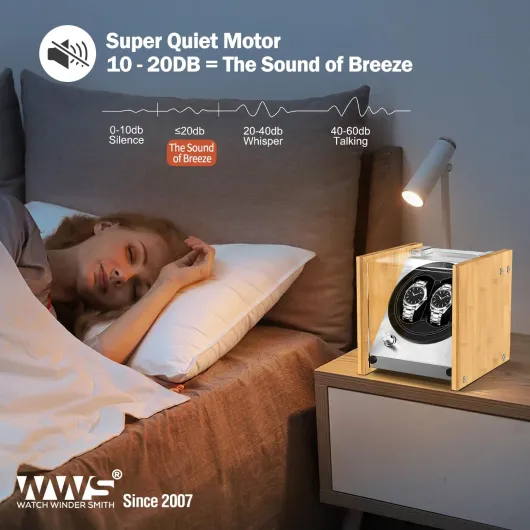
The noise level is where this thing really beats the cheap winders. The Mabuchi motor is genuinely quiet. We’re talking roughly “background hum” level, around what they claim (10–20 dB). In a living room or office, you just don’t notice it unless you’re really listening for it. In a bedroom at night, if you’re very sensitive to any noise, you might hear a faint movement when it starts a cycle, but it’s far from annoying. Compared to my old winder that had a constant buzzing, this one is miles better.
Rotation is smooth, no jerky starts or stops, which is reassuring for the watch mechanism. The cups don’t suddenly jolt or slam from one direction to another. The only small annoyance is that blue LED that turns on while it runs. It doesn’t affect performance, but if the winder is in a dark room, you’ll notice the light more than the motor sound. Overall, in terms of doing its main job—keeping two automatic watches running quietly and reliably—it gets the job done well.
What you actually get out of the box
Out of the box, you get the winder itself, four pillows, a power adapter, a little wiping cloth for the glass, and a basic user manual. Nothing fancy, but everything you need is there. The manual is straightforward: it explains the different rotation modes and how to set the turn-per-day options with the rotary dials on the front. You don’t need to be a watch nerd to understand it; it’s pretty plug-and-play.
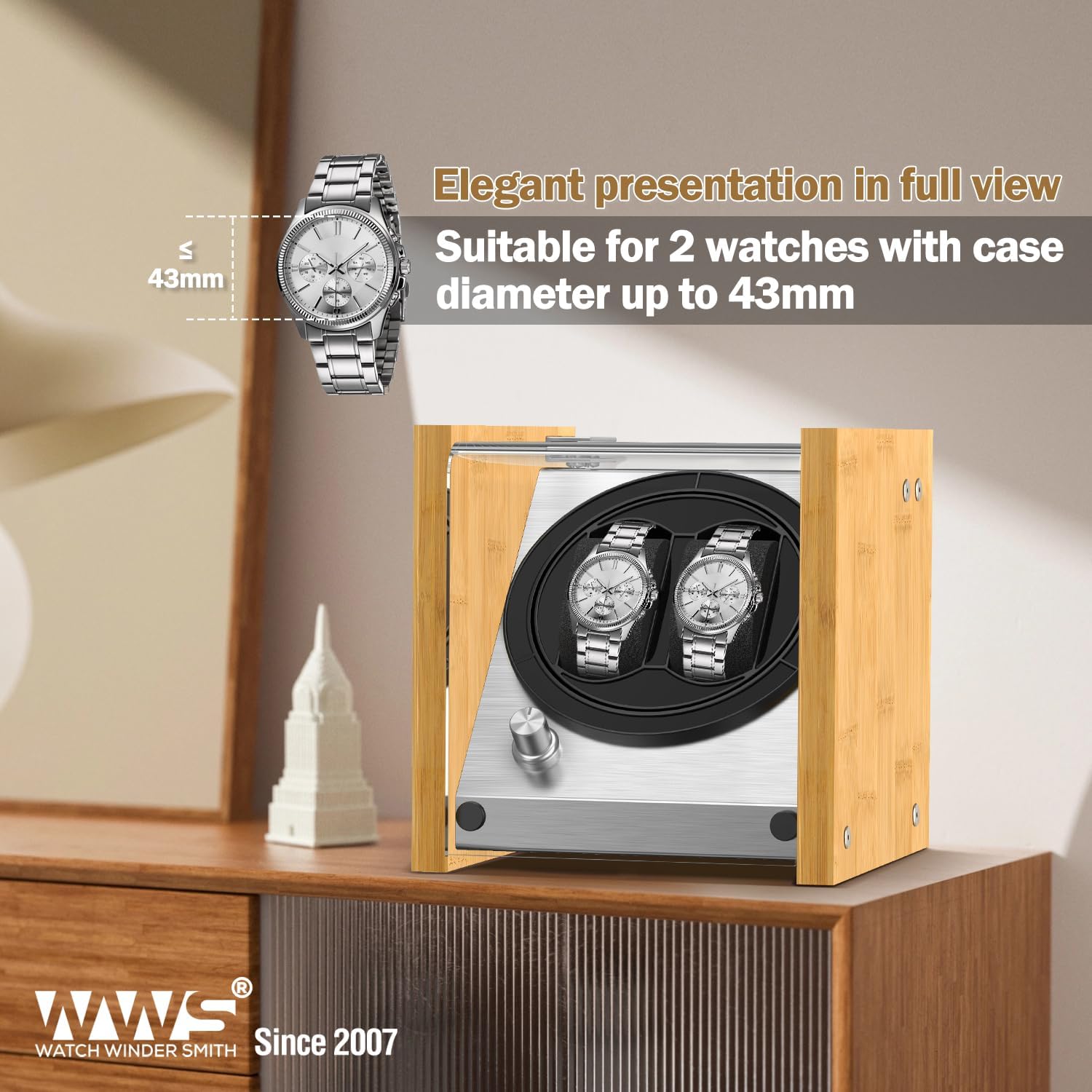
The winder is meant for two automatic watches (up to about 43 mm case diameter according to the specs). In reality, you can squeeze slightly larger watches in there, but once you get past 43–44 mm, you’re close to the glass when it spins, and you start worrying about the watch touching the lid. For regular dress watches and most sports watches, it’s fine. If you’re into big chunky 45–47 mm divers, I’d be a bit more cautious.
On the front, you’ve got two separate rotary switches, one for each watch. That’s actually useful if you have, say, a daily beater that needs more motion and a dress watch that you only wear occasionally. You can set each side independently for different rotation directions and cycles. The dials themselves feel surprisingly good: they click into place like old-school hi-fi knobs, which is a nice touch and makes it feel less cheap.
Overall, the presentation is simple and practical. No pointless LED displays or touchscreen nonsense. Just dials, a power socket at the back, and a clean bamboo box with a glass window. The only slightly gimmicky part is the blue light that turns on while the watches rotate. Some people might like it; personally, I think it’s unnecessary and can be a bit annoying in a dark room. But it’s not a deal-breaker, just a small annoyance if you’re sensitive to lights at night.
Pros
- Very quiet Japanese Mabuchi motor, suitable for living room or office use
- Bamboo wood housing and glass front look and feel more solid than cheap plastic winders
- Independent controls and multiple rotation modes for each of the two watches
Cons
- Supplied memory foam cushions deform and can let the watch move or touch the lid
- Blue LED light during rotation feels unnecessary and can be annoying in dark rooms
Conclusion
Editor's rating
Overall, the Watch Winder Smith bamboo double winder is a solid mid-range choice if you own a couple of automatic watches and want something that both works and looks decent. The big positives for me are the quiet Japanese motor, the bamboo housing that doesn’t look cheap, and the independent controls for each watch. In day-to-day use, it does exactly what you want: it keeps your watches running, doesn’t make much noise, and sits on a shelf without looking out of place.
It’s not perfect, though. The stock memory foam cushions are a bad idea in my opinion: they deform, end up a bit too small for the cups, and can let the watch move around more than you’d like. The quick fix is to use your own cushions, but still, it’s a weak point. The blue light that turns on when the watches rotate also feels unnecessary and a bit cheap, especially if the winder is in a bedroom. None of this kills the product, but it stops it from being a no-brainer.
If you have two automatics, care about quiet operation, and want something that looks like a small wooden display box instead of a plastic gadget, this is a good option for the price. If you’re extremely picky about every detail or have very large watches (over 44 mm), you might want to look at higher-end or larger models. For most everyday users with a small collection, though, this winder gets the job done in a clean, practical way and feels like money reasonably well spent.