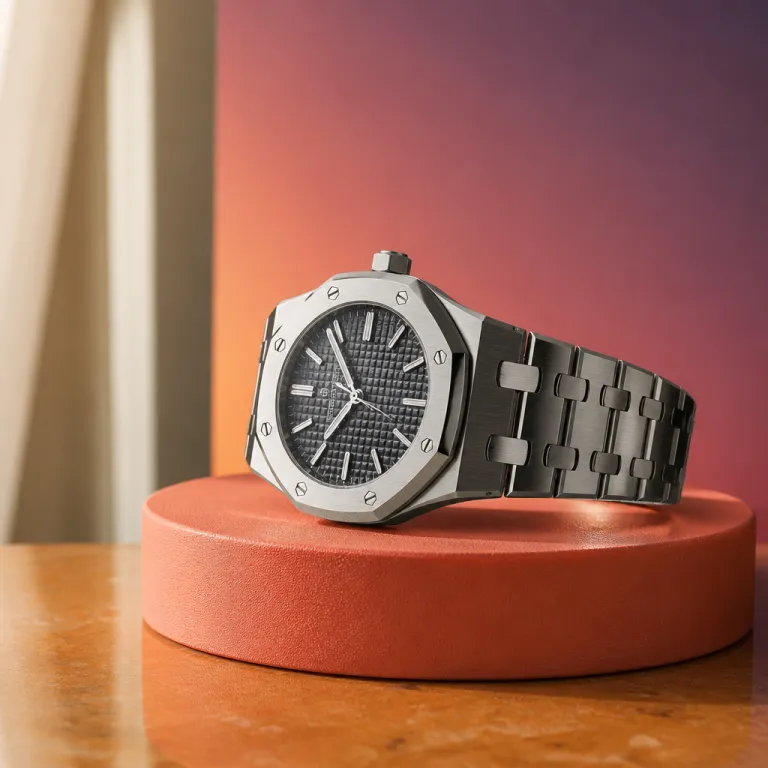
The Audemars Piguet Royal Oak 15400 guide every 41 mm collector needs
The audemars piguet royal oak guide every 41 mm collector needs
The Royal Oak 15400 is the reference that still anchors any serious Audemars Piguet Royal Oak guide for modern 41 millimetre cases. It sits at the crossroads between the original Gérald Genta spirit and the contemporary sports watch expectations that shape today’s market, which is exactly why many collectors quietly rate it above the later 15500 models. When you handle several Royal Oaks side by side, the 15400 is the one that feels most like a true Piguet Royal wristwatch rather than a product of focus groups.
Start with the basics; this is a 41 millimetre Royal Oak watch that wears flatter than its numbers suggest thanks to a case thickness of about 9.8 millimetres and a sharply tuned integrated bracelet. The stainless steel case and bracelet architecture still echo the original Royal Oak Jumbo, but the 15400 adds just enough dial real estate and bracelet taper to work as a daily sports watch for wrists from roughly 16 to 18.5 centimetres. In a crowded oak collection of modern references, that balance of case, bracelet and dial proportions is what keeps the 15400 at the centre of so many conversations about long term wear.
Any honest Audemars Piguet Royal Oak guide must also acknowledge how the 15400 bridges generations of movements and dial design. It carries the in house calibre 3120, a movement that may not win spec sheet battles but has proven itself in steel and gold Royal Oaks over long service intervals. When you compare pre owned watches in the current market, the 15400 often shows cleaner dials, crisper tapisserie and less bracelet stretch than younger 15500 models that have seen the same daily use, a pattern echoed in dealer reports and auction results from the early 2020s, even if exact figures vary by sale and region.
Dial layout and tapisserie texture: why the 15400 reads “Royal Oak” at a glance
Look at the dial first, because that is where the Royal Oak 15400 quietly outclasses its successor. The applied hour markers on this reference are longer and slimmer, which gives the tapisserie pattern more room to breathe and keeps the dial text balanced between the Audemars Piguet signature, the automatic line and the “Swiss made” at six. On the 15500 models, the markers grow thicker, the date window moves, and the whole dial starts to feel more like a generic luxury sports watch than a sharp Piguet Royal statement.
 The 15400’s grande tapisserie dial, especially in blue, has become a benchmark for many collectors building their own Audemars Piguet Royal Oak guide. Its squares catch light differently across the dial, so the watch shifts from almost black to electric navy as you tilt the steel case and bracelet, which is exactly what you want from a Royal Oak on the wrist. When you compare several Royal Oaks in stainless steel, pink gold and titanium, the 15400’s dial remains the one that best translates Gérald Genta’s original design language into a modern daily watch.
There is also the matter of text and logo placement, which sounds academic until you live with the watch for a few months. On the 15400 reference, the applied AP logo sits just below twelve, leaving enough space for the full Audemars Piguet name without crowding the upper dial, while the lower half stays clean with only the necessary lines. If you are used to studying chronograph layouts like the Tudor Big Block in detailed reviews of luxury chronographs, you will immediately notice how the 15500’s dial feels busier and slightly top heavy compared with the calmer, more legible 15400 dial design.
Case, bracelet and wrist feel: where 0.6 mm changes everything
On paper, the difference between a 9.8 millimetre case and a 10.4 millimetre case seems trivial. On the wrist, that extra thickness on the 15500 reference shifts the Royal Oak from a sleek sports watch to something closer to a compact diver, especially when the integrated bracelet is sized snugly. The 15400 keeps the case low enough that the bracelet can drape naturally, which is why so many pre owned examples still feel tight and precise after years of wear.
 The integrated bracelet is the real secret weapon in any Audemars Piguet Royal Oak guide, and the 15400’s bracelet taper is close to ideal for a 41 millimetre Royal Oak. Links step down gradually from the case to the clasp, so the watch hugs the wrist rather than perching on top of it, and this is true whether you choose stainless steel, rose gold or two tone gold models. When you compare the bracelet feel to other sports watches with integrated bracelet designs, such as the AP Safari mentioned in in depth collector pieces, the 15400 still feels like the purest expression of the Royal Oak idea.
Lug to lug length is another underappreciated factor that this reference gets right. The 15400 stretches just enough across the wrist to show off the octagonal bezel and brushed case flanks without letting the bracelet flare out awkwardly, which can happen on thicker Royal Oaks in titanium or yellow gold. If you have ever tried a Royal Oak Offshore and found the case and bracelet too top heavy, the 15400 will feel like the antidote; flat, balanced and quietly confident.
Calibre 3120 versus 4302: movement architecture, reliability and service reality
Under the sapphire case back, the Royal Oak 15400 runs on the calibre 3120, a movement that has powered many Audemars Piguet models across the collection. It beats at 3 hertz (21,600 vibrations per hour), offers a power reserve in the 60 hour range and carries a full balance bridge, which helps stability over time when the watch takes real world knocks. The 15500’s calibre 4302 brings a higher beat rate of 4 hertz (28,800 vibrations per hour), an extended power reserve of about 70 hours and a slightly more modern architecture, but that does not automatically make it the better choice for a long term daily Royal Oak.
 Collectors who track service histories across pre owned Royal Oaks often report that the 3120 has settled into a predictable pattern of wear, parts replacement and regulation. Watchmakers know the calibre well, parts are widely available within the brand’s network, and the movement has already proved itself in stainless steel, pink gold and even diamond set references that see demanding use. The 4302 is still building that track record, and while it looks impressive through the case back, the real test for any movement in an Audemars Piguet Royal Oak guide is how it behaves after a decade of bracelet desk diving and occasional knocks on door frames.
There is also a philosophical point here that matters to serious Royal Oak collectors. The 3120 connects the 15400 to earlier Royal Oaks and even to some perpetual calendar and Jumbo references that share similar movement DNA, while the 4302 feels like the start of a new chapter that is not yet fully written. If you are choosing one watch to represent the modern Piguet Royal era in your oak collection, the 15400 with its calibre 3120 still tells a more complete story than the newer 15500 with its calibre 4302.
Secondary market reality: pricing, CPO absorption and why the 15400 holds the line
On the secondary market, numbers tell a story that marketing campaigns rarely admit. As of the current grey market data compiled by major pre owned platforms and auction summaries published between 2021 and 2023, equivalent condition Royal Oak 15500 watches often trade roughly 5 to 15 percent below comparable 15400 models, which is unusual for a newer reference that should, in theory, command a premium. That spread reflects collector preference more than scarcity; people who have handled both references simply prefer how the 15400 looks and feels.
Full set 15400 watches in stainless steel with blue tapisserie dials consistently sit at the top of the pricing band, followed by black and silver dials, while 15500 references in similar configurations lag slightly behind. When Audemars Piguet’s official certified pre owned programme, announced in late 2022 and rolled out through selected boutiques, ramps up, the 15400 is almost certain to be a priority absorption reference because it anchors the modern 41 millimetre Royal Oak story and offers predictable service outcomes. That CPO attention will likely stabilise prices further, especially for clean pre owned examples with minimal bracelet stretch and unpolished cases.
For aspiring collectors working within a defined budget, this creates a clear decision tree. If you want the most dial for your money and do not mind a slightly thicker case, a 15500 reference can be a rational choice, especially if you find one with a fair retail price relative to condition and service history. If you care more about long term wear, balanced design and the way a Royal Oak should feel after ten years, the 15400 remains the smarter buy, much like choosing a quiet Rolex that barely seems to tick once you understand why some luxury watches sound almost silent on the wrist.
The collector case: when the older reference is the better Royal Oak
Every serious Audemars Piguet Royal Oak guide eventually reaches the same conclusion; the 15400 is the reference that best captures what a modern Royal Oak should be. It is not the thinnest Royal Oak Jumbo, nor the most complicated perpetual calendar, nor the flashiest diamond set Piguet Royal showpiece, yet it is the watch that owners keep coming back to after trying more exotic models. That pattern matters more than any single specification or marketing claim.
Think about how collectors talk about other brands when they compare icons like Patek Philippe Nautilus references or vintage chronographs such as the Tudor Big Block in detailed brand spotlight articles. There is always one reference that quietly becomes the benchmark, the one against which all later models are judged, and for the 41 millimetre Royal Oak that benchmark is the 15400. It threads the needle between daily sports watch practicality, integrated bracelet comfort and dial design purity in a way that newer Royal Oaks in white gold, yellow gold or titanium sometimes miss.
If you are building an oak collection with one core Royal Oak and perhaps a more specialised piece like a rose gold perpetual calendar or a gold pink diamond set model for high days, the 15400 is the rational centre of gravity. It gives you the classic grande tapisserie dial, the proven calibre 3120 and the case and bracelet proportions that still feel right after a decade of wear. This is not the press release, but the wrist presence after ten years, the sort of lived experience that underpins any credible buyer’s guide or movement deep dive.
Key figures that shape the Royal Oak 15400 market
- Royal Oak 15400 case thickness is approximately 9.8 millimetres, while the 15500 measures about 10.4 millimetres, a 6 percent increase that noticeably changes wrist feel and bracelet drape.
- The 15500 typically trades 5 to 15 percent below the 15400 on the secondary market in equivalent condition, based on aggregated dealer listings and auction hammer prices reported since around 2021, showing a clear collector preference for the older reference despite its shorter power reserve.
- Calibre 3120 service intervals commonly run around 5 to 7 years in regular use, which aligns with many other high end automatic movements and supports the 15400’s reputation as a reliable daily Royal Oak, according to watchmaker interviews and brand service guidance.
- Case diameter of 41 millimetres on the 15400 suits wrist sizes from roughly 16 to 18.5 centimetres, covering the majority of male collectors looking for a versatile luxury sports watch.
- Integrated bracelet construction on the 15400 uses multiple small links near the clasp, which reduces perceived bracelet stretch over time compared with some thicker Royal Oak references that rely on larger links.
FAQ about the Royal Oak 15400 and its place in the Audemars Piguet line
Why do collectors prefer the Royal Oak 15400 over the 15500 ?
Collectors tend to prefer the Royal Oak 15400 because its dial layout, case thickness and bracelet taper feel closer to the classic Royal Oak design language. The slimmer markers, balanced text and lower profile case give it a more refined presence than the 15500, which many find slightly bulkier on the wrist. That combination of proportions and proven calibre 3120 reliability keeps demand and prices higher for the 15400 in the current market.
Is the calibre 3120 in the 15400 less advanced than the 4302 in the 15500 ?
The calibre 3120 is technically older and offers a shorter power reserve than the 4302, but it has a longer track record in Royal Oak models. Watchmakers are very familiar with its architecture, and parts availability within the brand’s network is strong, which supports predictable servicing. For many buyers, that proven reliability outweighs the incremental technical gains of the newer 4302 movement.
How does the 41 mm Royal Oak 15400 wear compared with other sports watches ?
The 41 millimetre Royal Oak 15400 wears flatter and more compact than many other sports watches with similar diameters because of its 9.8 millimetre thickness and integrated bracelet. The case hugs the wrist, and the bracelet tapers smoothly, so it feels more like a refined bracelet watch than a chunky tool watch. On wrists around 16 to 18.5 centimetres, it usually sits perfectly without overhang.
Is a pre owned Royal Oak 15400 a safe purchase for a first serious luxury watch ?
A well documented pre owned Royal Oak 15400 can be a strong first serious luxury watch if you buy from a reputable dealer and verify service history. The reference has a solid movement, robust case and bracelet construction and strong liquidity on the secondary market, which helps protect value. As Audemars Piguet’s certified pre owned programme expands, vetted 15400 examples should become even easier to source with confidence.
Where does the 15400 sit within a broader Royal Oak collection ?
Within a broader Royal Oak collection, the 15400 often serves as the core daily wearer around which more specialised pieces are added. Collectors might pair it with a thinner Jumbo for dress use, a perpetual calendar for complication interest or a more colourful rose gold or diamond set reference for occasional wear. The 15400’s balanced design and proven movement make it the natural anchor for such a collection.