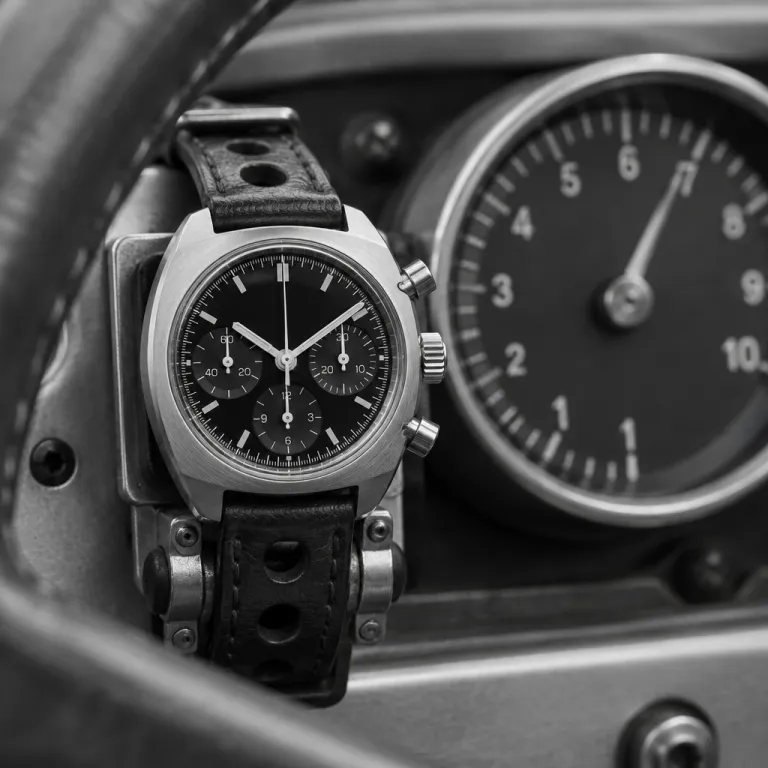
From Monza racetrack to wrist icon status
The story of the Heuer Monza begins at the Autodromo Nazionale di Monza, where 1970s Formula 1 intensity shaped its character. Introduced in 1976 to celebrate Niki Lauda’s 1975 World Drivers’ Championship with Scuderia Ferrari, this Monza chronograph was conceived as a purpose-built instrument, translating cockpit legibility and timing precision into a compact steel case for the wrist. Every serious racing enthusiast who studies historic Heuer watches eventually encounters this bold cushion-shaped watch and its unmistakable presence.
While the Monaco captured attention with its square case, the Heuer Monza offered a more ergonomic profile that hugged the wrist with ease. The original Monza Calibre 15 layout combined a tachymeter and pulsometer scale, allowing drivers and team doctors to read speed and pulse directly from the dial during long-distance events. This dual-scale chronograph design made Monza watches far more than lifestyle accessories, turning each early reference into a genuine tool for professionals who lived by the stopwatch.
Collectors today value how each limited-edition TAG Heuer Monza reflects a specific era of racing culture and mechanical innovation. The earliest Heuer Monza models were linked to Ferrari’s mid-1970s Formula 1 success, while later Monza chronograph editions showcased evolving calibre technology and changing aesthetics in stainless steel and other materials. Across these generations, the watch remained faithful to its core mission, delivering clear hours-and-minutes indications and robust timing functions under intense track conditions.
Design language of the heuer monza versus other racing legends
When enthusiasts compare the Heuer Monza to the Monaco and Carrera, they are really comparing three distinct philosophies of racing watch design. The Monaco chronograph is famously angular and architectural, while the Carrera line pursues a cleaner, more minimalist dial and case profile for pure legibility. By contrast, the Monza watch blends curves and edges, with a cushion-shaped stainless-steel case that feels compact yet visually powerful on the wrist.
On most modern Monza calibre references, the dial balances bold Arabic numerals, contrasting sub-registers, and a date window that remains discreet yet functional. The hours-and-minutes hands are often treated with luminous material, ensuring that the chronograph remains readable in low-light conditions, whether in a pit lane or during night driving. This careful hierarchy of information on the dial means that Monza watches rarely feel cluttered, even when both tachymeter and pulsometer scales are present around the periphery.
For collectors who already appreciate other motorsport icons, the Heuer Monza offers a complementary narrative rooted in asphalt rather than ocean depths. Where a Carrera chronograph might suit formal occasions, the Monza case and bracelet combinations lean slightly more aggressive, especially in darker coated steel or perforated leather strap configurations. Yet even the most radical limited-edition Monza chronograph retains a certain elegance that allows it to transition from circuit to city without losing coherence.
Case, materials, and the evolution of monza ergonomics
The earliest Heuer Monza models used compact cases around 39 millimetres that sat low on the wrist, a deliberate choice to avoid snagging on racing overalls or gloves. Over time, TAG Heuer experimented with different case materials, moving from traditional steel to lightweight alloys and high-tech composites, while always keeping the Monza silhouette instantly recognizable. Modern stainless-steel Monza chronograph editions often measure around 42 millimetres, striking a balance between presence and comfort for contemporary tastes.
Case finishing plays a crucial role in how each edition TAG Heuer Monza is perceived by connoisseurs. Brushed surfaces on the top of the case reduce glare under harsh track lighting, while polished bevels along the edges catch the light and emphasize the cushion geometry. On some limited-edition models, black-coated stainless steel or titanium cases reinforce the motorsport connection, echoing the dark tones of racing helmets, steering wheels, and dashboard instruments.
Although many enthusiasts associate the Monza with leather straps, the presence of a stainless-steel bracelet on certain watches adds versatility and durability. A well-executed bracelet can transform the character of the watch, making Monza calibre references feel more like daily wearers than purely weekend racing pieces. The ergonomic sophistication of the Monza case demonstrates how thoughtful design can make even bold chronographs surprisingly wearable.
Dial architecture, calibre choices, and functional clarity
Inside the Heuer Monza, the calibre has always been more than a technical specification; it is the engine that defines the watch experience. Early mechanical movements such as the Calibre 15 provided automatic reliability with an off-centre running seconds display, while later Monza calibre variants introduced updated self-winding chronograph architectures without sacrificing precision. TAG Heuer has consistently tuned these calibres to deliver crisp chronograph engagement, ensuring that each press of the pusher feels decisive and mechanically satisfying.
The dial architecture of the Monza chronograph reflects this mechanical seriousness, with sub-dials positioned for intuitive reading of elapsed minutes and running seconds. A framed date window, usually at 6 or 3 o’clock, offers practical information without overwhelming the primary time display of hours, minutes, and central chronograph seconds. Applied indices, contrasting colour accents, and carefully proportioned typography all contribute to a dial that remains legible at a glance, even when the watch is subjected to vibration and rapid movement.
Collectors often debate the merits of different Monza editions based on their calibre choices, preferring either traditional column-wheel chronograph mechanisms or more modern, modular architectures. Regardless of the specific movement, the Heuer Monza maintains a strong identity through its combination of cushion case, racing scales, and purposeful dial layout. This consistency across multiple limited-edition runs reinforces the model’s status as a true icon within the broader TAG Heuer portfolio of racing watches.
Bracelets, straps, and the tactile side of the monza
While the Heuer Monza is often discussed in terms of case shape and chronograph heritage, the choice of bracelet or strap dramatically influences how the watch feels in daily wear. A stainless-steel bracelet emphasizes the tool-watch roots of the Monza, adding weight and solidity that many enthusiasts associate with professional equipment. In contrast, a perforated leather strap evokes vintage driving gloves and steering wheels, reinforcing the emotional link between the watch and classic racing.
TAG Heuer has used both integrated and traditional lug designs on various Monza editions, allowing collectors to experiment with different strap materials and colours. On some limited-edition models, the bracelet features alternating brushed and polished links that echo the finishing on the case, creating a cohesive visual flow from lug to clasp. Rubber straps, though less common on Monza watches than on pure dive models, offer a modern, sporty option for those who want maximum comfort and sweat resistance during active wear.
For enthusiasts building a broader collection that might include refined dress pieces or other sports icons, the tactile variety offered by the Monza is a major advantage. Switching from a stainless-steel bracelet to a supple leather strap can transform the watch from a track-focused instrument into a more understated companion for evening events. This adaptability, combined with the enduring appeal of the Monza chronograph design, helps explain why the model continues to attract both seasoned collectors and newcomers to TAG Heuer.
Collecting strategies, limited editions, and digital era storytelling
Serious collectors approach the Heuer Monza with a clear strategy, often focusing on specific limited-edition releases that mark milestones in the brand’s racing narrative. A Monza chronograph produced in a small run, with a distinctive dial colour or commemorative case-back engraving, can command a premium over standard production watches. These limited-edition TAG Heuer Monza models appeal not only because of scarcity, but because each edition tells a precise story about motorsport partnerships, technological advances, or design experimentation.
In the digital era, the way enthusiasts share their passion for the Monza has changed, but the underlying emotion remains the same. Collectors post detailed wrist shots of their favourite Monza calibre references, often highlighting the interplay between the stainless-steel case, the dial textures, and the bracelet or strap choice. Many owners use social platforms to share on Facebook or other networks, creating informal archives of Monza watches that help new buyers understand subtle differences between editions and production periods.
TAG Heuer itself leverages these communities by encouraging fans to share on Facebook and other channels whenever a new edition TAG Heuer Monza is launched. This two-way dialogue between brand and collectors reinforces trust, as real-world owners provide feedback on case comfort, chronograph performance, and long-term reliability. For anyone considering their first Heuer Monza, studying these shared experiences can be as valuable as examining technical specifications, because they reveal how the watch behaves in everyday life rather than only under display lights.
Key figures and market context for the heuer monza
- TAG Heuer reported that chronograph models, including the Heuer Monza, represent a significant share of its sales mix, with sports watches accounting for a majority of revenue according to industry analyses by Morgan Stanley and LuxeConsult (for example, the 2023 Swiss Watch Industry Report).
- Average case sizes for modern racing chronographs have increased from around 38 millimetres to approximately 42 millimetres over the past two decades, aligning current Monza chronograph dimensions with broader market preferences for larger, more legible sports watches.
- Limited-edition releases across the Swiss watch industry have grown steadily, with hundreds of new limited series launched annually, and Monza limited editions participate in this trend by offering collectors scarcity and specific storytelling around motorsport heritage.
- Secondary-market data from platforms such as Chrono24 and WatchCharts show that well-preserved vintage Heuer Monza models can trade at multiples of their original retail prices, with many listings and auction results in the low-to-mid four-figure range in Swiss francs, reflecting strong demand for historically important racing watches.
- Global exports of Swiss watches have exceeded 20 billion Swiss francs in recent years according to the Federation of the Swiss Watch Industry (FH), and chronograph watches like the Monza contribute significantly to the value segment above 3,000 Swiss francs.
FAQ about the heuer monza
Why is the heuer monza considered an iconic racing watch ?
The Heuer Monza is regarded as iconic because it was designed specifically for motor racing, combining a cushion-shaped case, tachymeter and pulsometer scales, and robust chronograph functions. Its close association with 1970s Formula 1 history and its distinctive design language set it apart from other sports watches. Over time, both vintage and modern editions have built a strong following among collectors who value authentic racing provenance.
How does the heuer monza differ from the monaco and carrera ?
The Monza uses a cushion-shaped case that sits between the square geometry of the Monaco and the round, minimalist profile of the Carrera. While all three are chronograph-focused, the Monza often features dual scales and bolder dial contrasts that emphasize its tool-watch origins. Collectors typically choose the Monza when they want a racing watch with strong personality and ergonomic comfort.
Is the heuer monza suitable for daily wear ?
Modern Heuer Monza models are built with robust stainless-steel cases, reliable automatic calibres, and water resistance that make them suitable for everyday use. The choice between a bracelet and a leather strap allows owners to adapt the watch to office, casual, or weekend environments. As long as the chronograph pushers and crown are handled with normal care, the Monza performs well as a daily companion.
What should collectors look for when buying a vintage heuer monza ?
When evaluating a vintage Heuer Monza, condition of the dial, case, and movement is critical, as over-polishing or heavy restoration can reduce historical integrity. Collectors should verify reference numbers, serial ranges, and period-correct components such as hands, bezel, and crown. Consulting recognized experts and comparing with documented examples from auction houses helps ensure authenticity and fair pricing.
Do limited edition monza models hold their value better ?
Limited-edition Monza models often attract stronger demand because of their scarcity, unique design details, and specific links to motorsport events or partnerships. While no watch is guaranteed to appreciate, historically many well-known limited editions have shown resilient resale values compared with standard production pieces. Buyers should still prioritize personal preference and long-term enjoyment over purely speculative investment motives.