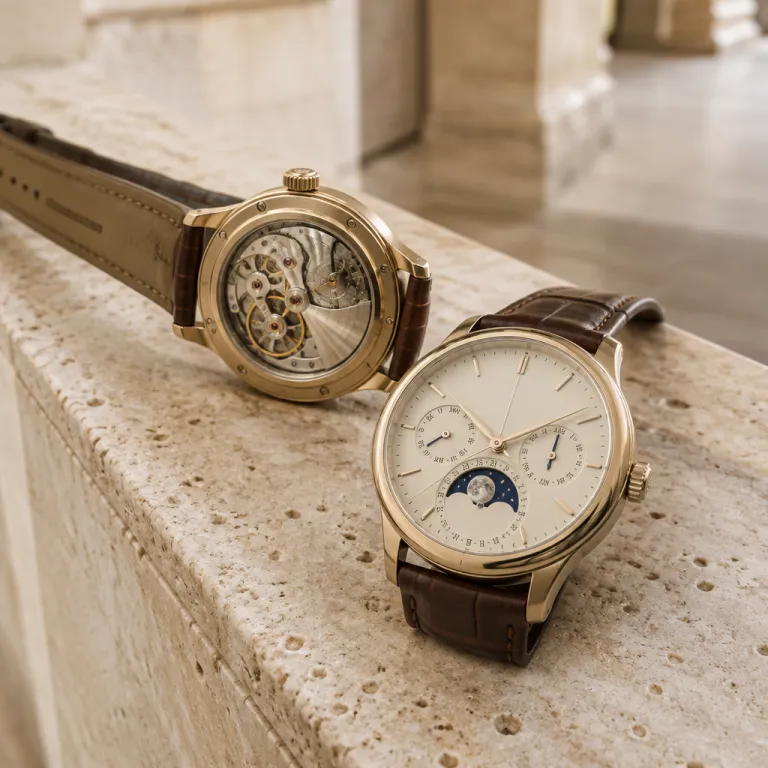
Why the moonphase complication seduces collectors who know better
The moonphase complication is the most poetic lie on your wrist. It tracks the moon and its changing phase against the earth with a tiny painted disc, while quietly reminding you that mechanical watches are about emotion first and precision second. For a female collector choosing between a travel watch, a calendar and a phase watch, the moonphase often wins because it turns the dial into a miniature sky moon rather than another data display.
Every serious moonphase watch guide should start with honesty about practicality, since the lunar cycle is 29.53059 days and your watch rounds that to something a gear train can handle. The standard solution is a 59 tooth gear driving a moon disc that shows two full moons per rotation, which means the current phase will drift by roughly one day every two and a half to three years as the teeth gear slowly accumulates error. That drift is not a flaw in the movement but a design choice, and it is exactly why most phase watches are bought for charm, not for astronomical navigation.
When you look at modern moonphase watches, you are really choosing how you want to read time as a story rather than a number. The best pieces balance the phase complication with a clean radial layout so the dial never feels crowded, letting the moon phases breathe visually while the rest of the complications stay legible. If you accept that the waxing and waning moon is there to please the eye more than to guide your days full of decisions, you will start judging these watches by aesthetics, finishing and long term movement reliability instead of brochure accuracy claims.
How a traditional moonphase works and why it drifts
Under the dial, a classic moon phase display is deceptively simple. A 59 tooth gear meshes with the calendar train and advances a semi exposed disc once every 24 hours, so that two complete lunar cycles are represented by two full moons printed on that disc. Because the true lunar cycle is slightly longer than 29.5 days, this standard moonphase complication will show the wrong current phase by about one day after roughly thirty months of continuous running.
Think of the mechanism as a compromise between poetry and engineering, where the moon earth relationship is reduced to a few wheels and a single teeth gear. The disc usually sits behind two crescent shaped apertures, and as it turns you see the phases moon transition from new to first quarter, then to full moon and finally to the last moon quarter before the cycle repeats. On most watches the same movement that drives the date also drives the phase complication, which is why you must never set the moon or the date when the watch is near its midnight changeover window.
For a collector who already owns a robust travel watch or diver, this kind of traditional moonphase watch guide matters because it explains what you are really paying for. You are not buying a scientific instrument that models the sun, earth and moon in three dimensional space, but a beautifully simplified phase watch that turns the sky moon into a rotating painting. If you can live with adjusting the moon phases every few years, a standard moonphase complication offers the best balance of cost, reliability and visual drama for daily wear.
A dedicated travel watch will always beat a moonphase for utility, yet the two can coexist in a focused collection.
High precision and astronomical moonphase: when engineering really matters
Once you understand the 59 tooth standard, the next step in any serious moonphase watch guide is the astronomical variant. Here the movement uses more elaborate gearing to match the lunar cycle far more closely, cutting the drift from one day every few years to one day every century or even longer. These high precision moon phases rely on complex teeth gear ratios that model the waxing and waning pattern of the moon around the earth with remarkable fidelity.
Brands such as A. Lange & Söhne, Jaeger LeCoultre and Patek Philippe have built moonphase complication systems where the disc will stay accurate for well over a human lifetime. In these watches the moonphase complication is often paired with a perpetual calendar, so the same movement that tracks leap years also keeps the current phase aligned with the true lunar cycle. When you see marketing language about astronomical moon earth displays, it usually means the watchmaker has invested heavily in the underlying phase complication rather than just printing a prettier sky moon on the dial.
For most collectors, especially women building a compact collection between 28 and 38 millimetres, that level of precision is intellectually satisfying but not strictly necessary. The real question is whether you value the engineering story enough to pay the premium, or whether you would rather allocate budget to a better finished dial, hand engraved details or a more wearable case profile. If you already own a high end calendar piece, as discussed in depth in this analysis of the perpetual calendar versus annual calendar trade off, then adding an astronomical moonphase might feel redundant unless the watch brings a radically different aesthetic.
How to read and set a moonphase without damaging the movement
Reading a moonphase is easy once you stop overthinking it. The aperture on the dial shows the illuminated portion of the moon disc, and you simply match that to the real sky moon or to a lunar calendar to know whether you are near a full moon or a new moon. Most modern phase watches also allow you to estimate the days until the next full moon by judging how far the disc has progressed along its radial path.
Setting the moonphase correctly is where many owners make expensive mistakes, because the phase complication is usually coupled to the date mechanism. The golden rule is simple ; never set the moon, the date or any calendar related complications when the hands are between roughly 20 00 and 02 00, since the movement may already be engaging the teeth gear that advances the disc. To be safe, move the hands to six thirty, then use the pusher or crown position dedicated to the moon phases to set moon alignment with the current phase shown on a reliable lunar cycle chart.
Once the moonphase is aligned, you only need to reset it after long periods off the wrist or after the expected drift interval for your specific movement. Some watches provide a scale on the back or in the manual that lets you read how many days full of error will accumulate over decades, which is a nice reminder that this is a mechanical approximation of the sun, earth and moon dance. Treat the phase moon display as a living complication that rewards gentle handling, and it will track your nights and days for many years without protest.
Aesthetics and finishing: where the romance really lives
The visual language of a moonphase often matters more than the specification sheet. On the dial side you will see everything from realistic photographic moons with craters to stylised faces, from deep blue aventurine sky moon backgrounds to minimalist lacquer that lets the disc float in negative space. For a female collector with a smaller wrist, the challenge is finding a phase watch where the moon phases feel integrated rather than squeezed into an already busy layout.
High end brands use layered discs, applied stars and even hand engraved moons to give depth to the aperture, turning a simple phase complication into a miniature tableau. This is where understanding traditional craft such as guilloché becomes useful, because a well executed engine turned pattern can frame the moon earth display and catch the light like ripples on water. If you want to go deeper into how such textures elevate a dial beyond mere printing, this detailed guide to hand engraved dials shows why some watches age gracefully while others feel flat after a few years.
At the extreme end of aesthetic and technical ambition sit pieces like the Ulysse Nardin Blast Moonstruck, which model the sun, earth and moon in a three dimensional layout that borders on sculpture. These watches are less about quietly tracking the current phase and more about wearing a mechanical planetarium, with multiple complications layered over a complex movement architecture. For most buyers, though, the sweet spot lies in a well proportioned dial where the waxing and waning disc adds just enough drama to make you glance twice at your wrist during the day.
Buying framework: which moonphase watches are actually worth it
Choosing a moonphase is easier when you accept that you are buying romance first. At the entry level of serious mechanical watches, prioritise a reliable movement, a comfortable case between 30 and 36 millimetres and a clear moon phase aperture that you can read at a glance. In this range a standard 59 tooth disc with a simple phase complication is perfectly adequate, and you should spend your money on better finishing rather than on marginal gains in lunar cycle accuracy.
In the mid tier, where you might be cross shopping a moonphase against a travel watch or a chronograph, think about how often you will actually use each complication. If your lifestyle involves frequent flights and time zone changes, a dedicated GMT will probably see more days full of wrist time than a poetic sky moon display, yet a well chosen phase watch can still anchor your dressier outfits. Look for movements with proven service histories, balanced radial layouts on the dial and thoughtful details like pushers that make it easy to set moon alignment without tools.
At the high end, astronomical moon phases and grand complications only make sense if you already own the basics and want a statement piece. Here you are paying for intricate teeth gear trains, ultra precise moonphase complication engineering and often a full suite of calendar complications wrapped around the moon earth display. The best advice is simple ; buy the watch whose waxing and waning disc still makes you pause after ten years, because that is the real test of value, not the press release but the wrist presence after ten years.
Key figures and technical benchmarks for moonphase watches
- A standard moonphase with a 59 tooth disc accumulates about one day of error every 2.5 to 3 years, because it approximates the 29.53059 day lunar cycle with a simplified 29.5 day model.
- High precision astronomical moon phases from brands such as A. Lange & Söhne or Jaeger LeCoultre can reduce that drift to one day in 122 years or more, using more complex gear ratios to track the lunar cycle.
- The synodic month, which defines the time between two consecutive full moons, averages 29.53059 days, and this small deviation from 29.5 days is what forces watchmakers to choose between simplicity and accuracy.
- Many traditional moonphase watches are designed so that the moon disc advances once every 24 hours, meaning that a stopped watch left unworn for ten days will require ten separate advances of the phase display to restore the correct current phase.
- Case sizes for moonphase watches aimed at female collectors increasingly fall between 30 and 36 millimetres, reflecting a shift away from oversized unisex designs toward more wearable proportions.
FAQ: practical questions about moonphase watches
How accurate is a typical moonphase watch in daily use ?
A typical moonphase watch using the standard 59 tooth disc will be effectively accurate for everyday use, drifting by about one day every two and a half to three years. For most owners that means a quick correction only a few times per decade, which is negligible compared with routine time and date adjustments. Astronomical moon phases improve this dramatically, but the practical benefit is mostly intellectual rather than functional.
Can I set the moonphase at any time of day ?
You should avoid setting the moonphase when the watch is near its date change window, usually between 20 00 and 02 00, because the calendar mechanism may already be engaged. The safest method is to move the hands to six thirty, then use the corrector or crown position dedicated to the moonphase to align it with a lunar calendar. This prevents damage to the teeth gear that advances the disc and protects the movement from costly repairs.
Is a high precision astronomical moonphase worth the extra cost ?
A high precision astronomical moonphase is worth the premium only if you value the underlying engineering and plan to keep the watch for many years. The improved accuracy, often one day in a century or more, has little impact on daily life but showcases the watchmaker’s ability to model the lunar cycle mechanically. For many collectors, especially those building a small but focused collection, a well executed standard moonphase offers better value.
What case size works best for a moonphase on a smaller wrist ?
For smaller wrists, especially in the 14 to 16 centimetre range, moonphase watches between 30 and 36 millimetres usually offer the best balance of presence and comfort. These sizes leave enough dial space for a readable moon phase aperture without overwhelming the wrist or pushing lugs over the edge. Always try the watch in profile, because lug length and curvature matter as much as nominal diameter.
How often should I service a moonphase watch ?
Most manufacturers recommend servicing a mechanical moonphase watch every five to ten years, depending on usage and environmental conditions. Regular servicing keeps the movement lubricated, ensures the teeth gear driving the moon disc remains properly aligned and prevents premature wear on the calendar components. If you notice difficulty when you set moon alignment or the date, that is a sign to consult a qualified watchmaker sooner.