Summary
Analysis score
Average of the criteria rated below
Value for money: strong specs, small QC risk
Design: Tudor-inspired diver with a clean black dial
Comfort and wearability: compact diver sizing done right
Materials and build: strong core specs with one weak link
Durability and water resistance: solid foundation with typical trade-offs
Performance: VH31 sweep quartz and real-world concerns
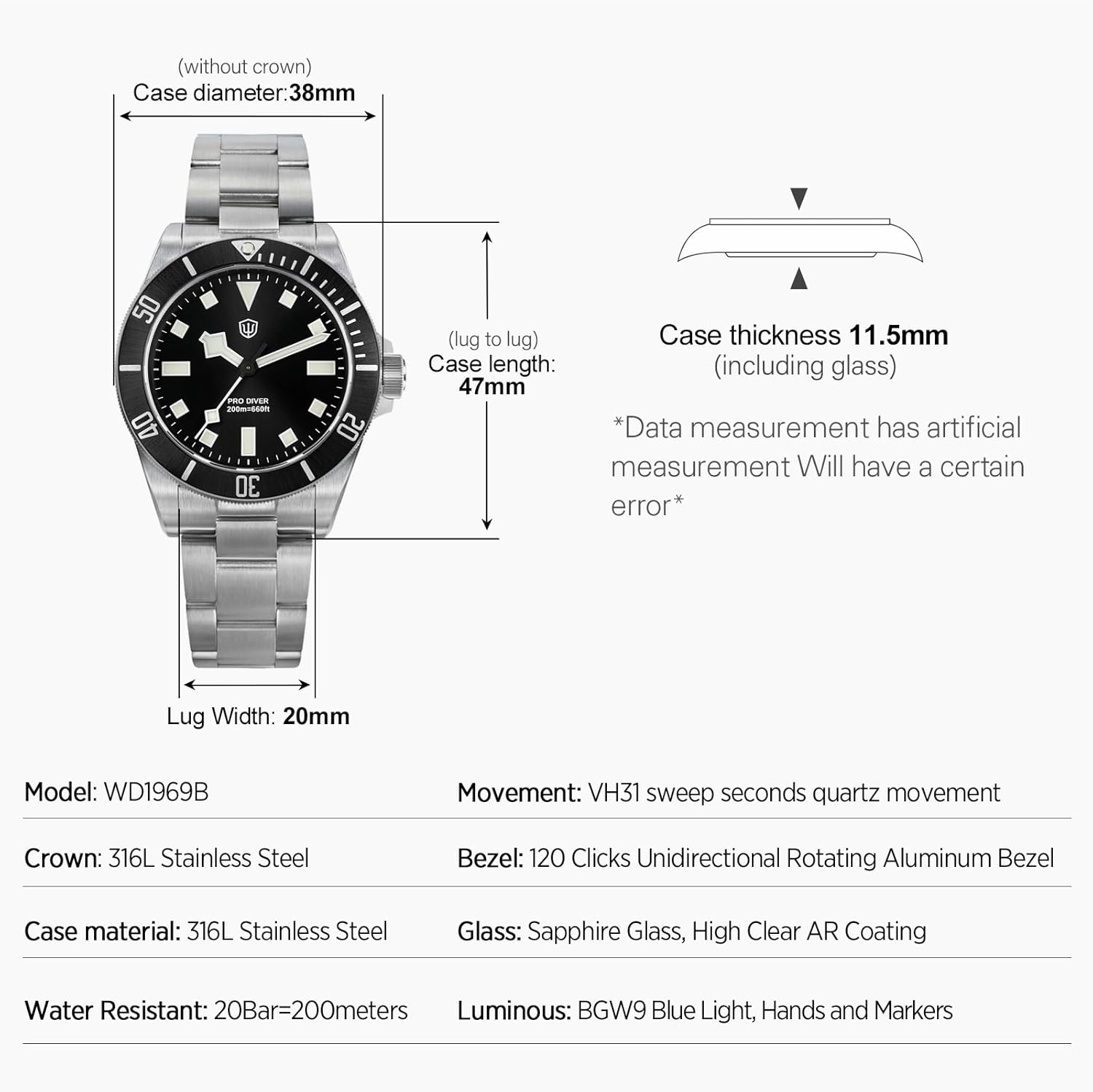
What the WD1969 Pro Diver offers on paper
Pros
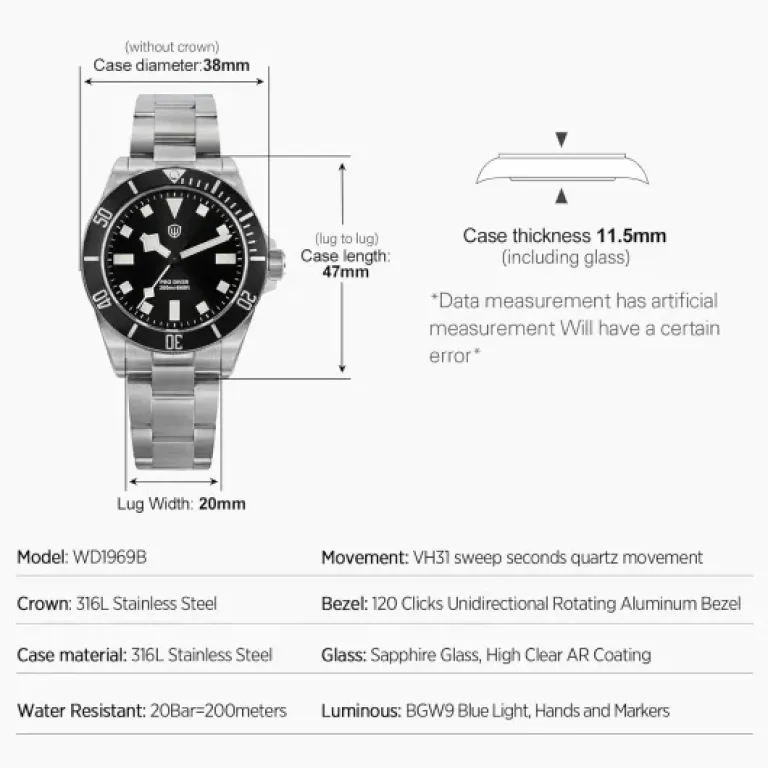
- Compact 38 mm case with 11.5 mm thickness, easier to wear than many bulky divers
- Sapphire crystal with AR coating and 200 m water resistance for solid daily and aquatic use
- VH31 Japanese quartz movement with smooth sweep seconds hand and quartz-level accuracy
Cons
- Aluminium bezel insert instead of ceramic, more prone to scratches and ageing
- At least one detailed report of loose minute hands, hinting at possible QC variability

Specifications
View full product page →| Brand | watchdives |
A compact diver that looks more expensive than it is
The watchdives WD1969 Pro Diver is clearly aimed at people who like the look of high-end Swiss dive watches but prefer quartz practicality and a lower price. On paper, it ticks a lot of boxes: a 38 mm case, 200 m water resistance, sapphire crystal with AR coating, and a Japanese VH31 quartz movement with a smoother sweeping seconds hand. The Amazon rating sits around 4.7/5 from just under twenty reviews, so early buyers are mostly positive about what they received.
What stands out immediately is the size and spec mix. Many affordable divers are 40–42 mm and can feel bulky on smaller wrists; here the 38 mm diameter and 11.5 mm thickness should keep things more compact. Add a full 316L stainless-steel case and bracelet, a screw-down construction implied by the 200 m rating, and this looks like a serious everyday watch for someone who swims or just wants the peace of mind of real water resistance.
There are, however, a few points to watch. One detailed German review mentions minute-hand play on two separate units, enough that the minute hand could jump about a minute when the watch was moved. That kind of alignment or tolerance issue is not ideal on a watch that otherwise sells itself on precise quartz timekeeping. Another English-language review also hints that the aluminium bezel insert feels like the weak link in an otherwise solid spec sheet, and suggests a ceramic insert would have made more sense at this level.
In my opinion, this model looks like a good-value, compact diver for people who prioritize design and convenience over mechanical movements. The specs are strong where it matters for daily wear: sapphire, lume, water resistance and a reliable Japanese quartz calibre. It is not flawless, though: the hand tolerance complaint and the aluminium bezel choice show where costs were likely cut. The real question is whether those trade-offs matter to you more than the combination of size, looks and ease of ownership.
Value for money: strong specs, small QC risk
The price is not displayed, but judging from the brand and feature set, the WD1969 Pro Diver clearly targets the affordable enthusiast segment rather than luxury. On the value side, it brings several features that are often missing at the lower end: a 38 mm compact case, sapphire crystal with AR, a 200 m water-resistance rating, BGW9 lume, and a Japanese VH31 quartz movement with a smooth seconds hand. These are not budget-bin specs. The Amazon average of 4.7/5 from 19 reviews also indicates that most buyers feel they got good value for what they paid.
Several comments reinforce this perception. One Spanish-speaking buyer highlights that this is one of those well-executed homage pieces that "functions very well" and appreciates the combination of quartz practicality with the appearance of an automatic. Another verified buyer praises the overall quality from watchdives and only criticizes the aluminium bezel insert, implying that the rest of the watch feels above its price point. Short but clearly positive comments in Italian and Spanish support the idea that, for many, the watch meets or exceeds expectations when it arrives.
The main value risk is quality consistency, especially concerning the minute-hand play mentioned in one detailed German review. Returning two units for the same issue is annoying and can erase the sense of a bargain, especially if you have to manage returns and replacements. However, this appears to be an isolated complaint among the published reviews rather than a pattern. If it were widespread, you would probably see more similar comments. Still, it is enough to suggest that the QC is not bulletproof, which is common in this price bracket but worth noting.
In my opinion, if you like the Tudor-inspired design, prefer a smaller 38 mm diver, and want quartz convenience with a sweep seconds hand, the WD1969 Pro offers good value on paper. The sapphire crystal, 200 m rating and BGW9 lume are features that can be hard to find together at a low price. The compromises are clear: an aluminium bezel instead of ceramic and a small but real risk of QC issues with hand fit. For someone comfortable with those trade-offs, it looks like a sensible buy. If perfect finishing and zero tolerance for defects are non-negotiable for you, spending more on a brand with stricter QC might be the safer path.
Design: Tudor-inspired diver with a clean black dial
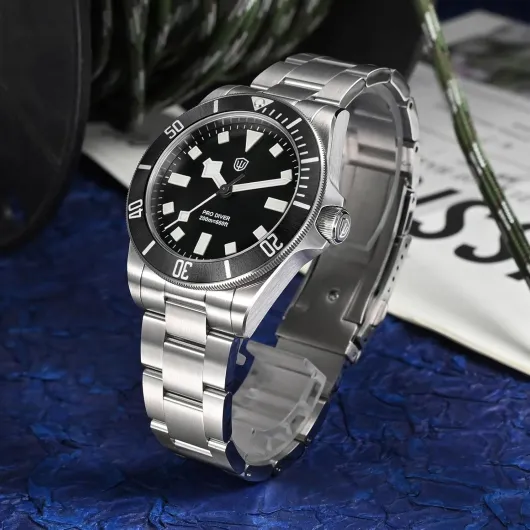
Design-wise, the WD1969 Pro Diver clearly plays in the "homage" category. One verified buyer explicitly calls out the "Tudor look" and praises the black matte dial with quadratic indices as the best-looking variant in the range. The dial is minimalist, with square or block markers and simple hands, plus a central seconds hand thanks to the VH31 movement. The color scheme on this version is straightforward: black dial, silver-tone stainless-steel case and bracelet, and a matching bezel with an aluminium insert. For someone who wants a classic diver aesthetic in a slightly smaller size, this layout should hit the mark.
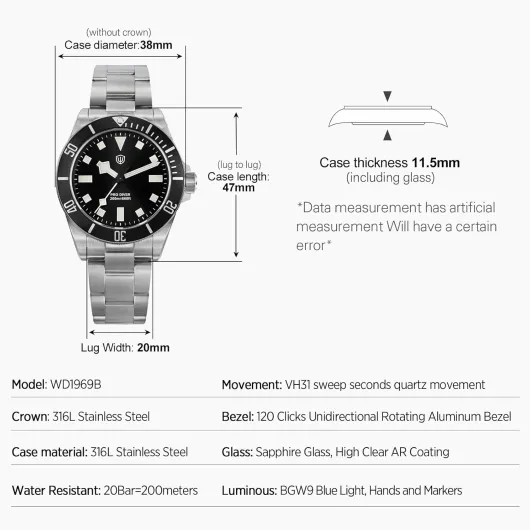
The 38 mm diameter is a deliberate design choice. Many mainstream divers sit at 40–42 mm, which can be too large for smaller wrists or for people who want a more restrained presence under a shirt cuff. At 11.5 mm thick, this watch should stay relatively low-profile while still having enough presence to feel like a diver. The 20 mm lug width also keeps the proportions balanced, avoiding the "luggy" look that some small cases get when paired with wide straps. The metal bracelet reinforces the tool-watch vibe while still working in more urban or office settings.
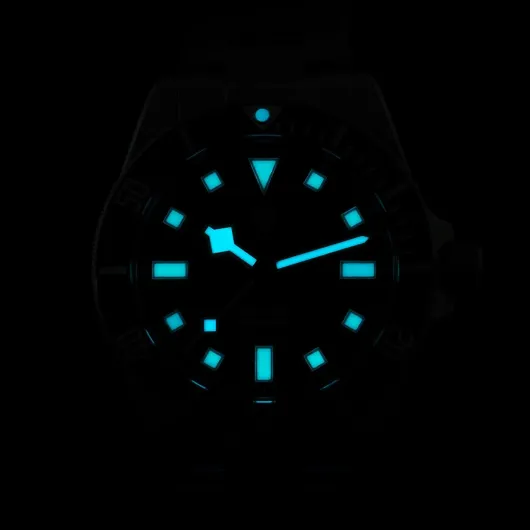
The lume choice, BGW9 in blue, is another design decision that gives the watch a modern, slightly cooler tone compared to the green commonly seen on cheaper divers. BGW9 usually appears white in daylight and glows blue in the dark, which matches well with a clean black dial and silver case. Several owners mention they are happy with the overall appearance, and short comments like "Bellissimo" and "Excelente reloj" suggest people are not disappointed by the way it looks in person, even if they do not go into technical detail.
On the downside, the aluminium bezel insert is the one aesthetic and functional element that feels dated compared to the rest. One English-language review specifically wishes for a ceramic bezel, which would resist scratches better and give a more upscale feel. Aluminium is cheaper and easier to manufacture, so its presence here likely helped keep the price down, but it is clearly a compromise. In my opinion, if you value long-term cosmetic durability of the bezel, this is something to keep in mind. Otherwise, the overall design seems coherent: a Tudor-inspired case and dial, compact sizing, and a modern sweep seconds quartz movement that visually mimics an automatic without the cost.
Comfort and wearability: compact diver sizing done right
Comfort is always subjective, but some things can be inferred from the dimensions and what buyers say. The WD1969 Pro Diver has a 38 mm case diameter and 11.5 mm thickness, which is on the smaller and slimmer side for a dive-style watch. On paper, that should make it more comfortable for daily wear than many 42 mm "slab" divers, especially for people with medium to smaller wrists. The 20 mm band width is a standard size that usually balances case size and strap comfort well, without feeling either too narrow or too bulky.
The watch uses a 316L stainless-steel bracelet, described as adjustable for a secure and comfortable fit. While there are no detailed Amazon comments about micro-adjustments or clasp design, buyers who comment on the watch generally seem happy, with no flood of complaints about poor fit or painful bracelet links. Simple positive comments like "Ottimo" and "Excelente reloj" next to 5-star ratings suggest that, at least for those users, wearing the watch did not present any major issues. One English review that focuses on the Tudor-like aesthetics also indirectly praises the overall feel and look, even if comfort is not explicitly detailed.
At roughly 325 g for the whole package (box included), the watch head and bracelet likely come in at a typical diver weight. It will not be feather-light like a small field watch on a nylon strap, but for someone used to steel divers, it should feel normal. The relatively modest thickness should also help with sliding under a shirt cuff and avoiding the "top-heavy" sensation some larger divers have. For people who prefer a watch they can forget on the wrist, the 38 mm footprint is a strong argument in its favour.
In my opinion, if you usually find 40–42 mm divers a bit too large or heavy, this model’s dimensions look promising. There is no detailed negative feedback about sharp edges, hair-pulling bracelets or awkward lugs among the published reviews, which is a good sign. That said, comfort always depends on wrist shape and personal tolerance, so it is not guaranteed. Still, the advertised compact size, standard 20 mm lug width and adjustable steel bracelet add up to a watch that, on paper, should be easy to wear all day for most adults.
Materials and build: strong core specs with one weak link
From a materials standpoint, the WD1969 Pro Diver is better equipped than many fashion watches in its segment. The case and bracelet are made from 316L stainless steel, the standard alloy for modern watches due to its corrosion resistance and skin-friendliness. For a watch positioned as a 200 m diver, this is the expected baseline, and it aligns with what buyers would want for swimming and regular exposure to water. The strap type is listed as a metal bracelet with a buckle-style clasp, which should provide a secure fit for sports like swimming or light diving.
The real highlight is the sapphire crystal with AR (anti-reflective) coating. Sapphire is much more scratch-resistant than mineral glass or acrylic, and AR coating helps reduce reflections and improve legibility in bright light. On a daily wear watch, this means the dial should remain clearer over time, at least in theory. The listing also mentions "scratch-resistant" as a special feature, which almost certainly refers to the sapphire. Many cheaper quartz divers skip sapphire to save costs, so its presence here strengthens the value argument.
The bezel insert, by contrast, is aluminium. This is where the materials story is less impressive. Aluminium is lighter and cheaper than ceramic but is prone to scratches and fading over years of use, especially if exposed to saltwater or frequent knocks. One English-speaking reviewer specifically points out that the aluminium bezel could use an update to ceramic, suggesting that this is probably the most obviously cost-cut material on the watch. If you are the type who wants your watch to look pristine after years of wear, this is a real factor; if you are fine with patina and minor marks, it may not bother you.
Inside, the VH31 Japanese quartz movement is a practical choice. It is not a luxury calibre but it is a known, reliable workhorse from a major manufacturer, with a pseudo-sweep seconds hand at 4 ticks per second. That gives some of the visual appeal of a mechanical movement without the maintenance and shock sensitivity. In my opinion, the materials package is solid where it matters most for longevity: stainless steel, sapphire, and a decent movement. The aluminium bezel is the obvious compromise, and if the brand ever releases a ceramic version, that would address the main material complaint raised in the reviews.
Durability and water resistance: solid foundation with typical trade-offs
Durability is one of the main selling points of a diver-style watch, and the WD1969 Pro Diver arrives with a solid theoretical foundation. The 316L stainless-steel case and bracelet are resistant to corrosion and should handle everyday bumps and moisture well. The watch is rated to 200 metres water resistance, which is a serious rating for a quartz diver. That level is generally associated with screw-down crowns and casebacks, even if the listing does not spell out the exact construction. The brand positions the watch as suitable for diving, fishing and swimming, and one of the main bullet points emphasizes that it is designed for an active lifestyle.
The sapphire crystal with AR coating is another key durability factor. Sapphire is highly resistant to scratches from everyday items like keys or doorframes, so the dial surface should remain clear over time. This is a noticeable advantage compared to mineral glass or acrylic, which can mark far more easily. The AR coating, while improving legibility, can itself be more prone to fine marks than the sapphire underneath, but that is a trade-off seen across the industry and not unique to this model.
The weaker link for long-term durability is the aluminium bezel insert. Aluminium bezels tend to pick up scratches and fading more quickly than ceramic, especially if the watch sees a lot of saltwater or rough use. One English-speaking reviewer directly calls out the aluminium insert as the one area that feels dated and suggests that a ceramic insert would be a clear improvement. From a longevity standpoint, this criticism is fair: over a few years, an aluminium bezel can show its age more than the rest of the watch, even if the movement and case are still performing well.
In terms of mechanical durability, the VH31 quartz movement is generally considered reliable, but the earlier-mentioned report of loose minute hands on two units hints at quality-control variance. That issue is more about assembly and hand fit than about the fundamental robustness of the movement, but for the owner the result is the same: less trust in the watch. Among the rest of the reviews, there are no repeated reports of immediate failures, broken bracelets or water-intrusion problems, which is reassuring. In my opinion, the WD1969 Pro Diver should hold up well as a daily watch if treated reasonably, with the main cosmetic ageing likely to show up on the aluminium bezel insert rather than the case, crystal or bracelet.
Performance: VH31 sweep quartz and real-world concerns
Performance for a quartz diver like this comes down to three main points: timekeeping accuracy, hand alignment/stability and legibility. The WD1969 Pro Diver uses a Japanese VH31 quartz movement with a central seconds hand that ticks four times per second, creating a smoother sweep. Quartz movements of this type usually offer more than adequate accuracy for daily use, often within a few seconds per month, far beyond what mechanical watches can manage. One Spanish-speaking buyer explicitly says they "love the VH31 movement" because it looks like an automatic but keeps quartz advantages, which suggests satisfaction with both the visual effect and the practicality.
However, one German review raises a real concern about hand stability. The buyer reports that on two separate units (one black, one blue), the minute hand had noticeable play and could jump by about a minute when the watch was moved. They speculate about poorly matched gears or loose hands, and note that similar issues are discussed in online forums for this movement. Both watches were returned. This is a serious criticism because it undercuts the whole point of choosing quartz for reliability and precision. Among the published reviews, this is the only detailed complaint of this type, but it is specific enough to take seriously.
On the positive side, the watch is advertised as having BGW9 blue lume on the hands and markers, which should provide good low-light legibility. BGW9 is known for a clean white look in daylight and a blue glow in darkness. Although Amazon comments do not go into depth about lume performance, no one calls it weak either, which would likely appear if it were truly bad. The sapphire crystal with AR coating should also help readability by cutting reflections, especially outdoors or under strong lighting.
In my opinion, if you get a unit without the hand-play issue, the performance package looks strong for the category: accurate quartz timekeeping, a visually pleasing sweep seconds hand, decent lume by spec, and good legibility with sapphire and AR. The problem is quality consistency. That single negative review about the loose minute hand on two units shows that some copies may slip through with assembly or movement-tolerance problems. For a watch in this segment, that is not entirely surprising, but it is still disappointing. If precise minute indication is critical to you, it might be worth checking alignment carefully when you receive the watch, or considering a brand with a longer track record in strict QC.
What the WD1969 Pro Diver offers on paper
The WD1969 Pro Diver is a 38 mm stainless-steel dive-style watch powered by a Japanese VH31 quartz movement. The case thickness is listed at 11.5 mm, with a 20 mm lug width, which means it should accept a wide range of third-party straps if someone wants to swap out the bracelet. The watch weighs about 0.33 kg including packaging, so the head and bracelet together are solid but not extreme by diver standards. It is rated to 200 metres water resistance and is marketed for diving, fishing and swimming, so it is clearly aimed at people who want to get it wet without worrying.
The dial on this specific variant is matte black with what the listing calls "quadratic indices" – essentially square or blocky markers – and a minimalist face style. Lume is BGW9 in blue on both hands and markers, which on paper is a good choice for legibility and a modern look. The crystal is sapphire with an anti-reflective coating, which is a real plus in this price segment where mineral glass is still common. The bracelet and case are 316L stainless steel, and the closure is described as a buckle/clasp on a metal bracelet, typical for this type of watch.
The movement is an important part of the pitch. The VH31 is a quartz calibre that makes the seconds hand tick four times per second, giving a smoother sweep that imitates an automatic movement while keeping quartz accuracy and low maintenance. Several buyers explicitly say they like this hybrid approach: one Spanish-speaking review mentions being pleased that it "looks like an automatic without being one, but with the advantages of quartz". The watch is battery powered as usual for quartz, with no advertised special power features, but VH31 movements are generally known for decent battery life.
Overall, the presentation is that of a compact, slightly dressy diver that borrows design cues from brands like Tudor, pairs them with a sweep quartz movement, and wraps it all in modern materials. On paper, nothing revolutionary, but the combination is coherent: 38 mm size for comfort, sapphire for durability, 200 m water resistance for peace of mind, and a bracelet for daily wear. The weak point, spec-wise, is the aluminium bezel insert, which feels a bit behind the curve when many microbrands are moving to ceramic, especially since at least one English review calls this out directly as something that could be improved.
Pros
- Compact 38 mm case with 11.5 mm thickness, easier to wear than many bulky divers
- Sapphire crystal with AR coating and 200 m water resistance for solid daily and aquatic use
- VH31 Japanese quartz movement with smooth sweep seconds hand and quartz-level accuracy
Cons
- Aluminium bezel insert instead of ceramic, more prone to scratches and ageing
- At least one detailed report of loose minute hands, hinting at possible QC variability
Conclusion
Analysis score
The watchdives WD1969 Pro Diver is, in my opinion, a well-thought-out compact diver for people who want the look of higher-end pieces without the cost or maintenance of a mechanical movement. The key strengths are clear: a wearable 38 mm case, 11.5 mm thickness, sapphire crystal with AR, BGW9 lume, and a 200 m water-resistance rating that should cover everything from showers to serious swimming. The VH31 Japanese quartz movement gives you both the visual appeal of a sweep seconds hand and the everyday accuracy and low-hassle nature of quartz. Most buyers on Amazon seem pleased, which is reflected in the 4.7/5 average rating.
It is not perfect, though. The aluminium bezel insert is the obvious cost-cutting choice and the one aspect that feels out of step with the rest of the spec sheet. More concerning, even if not widespread, is the detailed report of loose minute hands on two separate units, which raises a question mark about quality control on some batches. For many people, the combination of design, specs and likely price will outweigh these drawbacks, especially if they specifically want a smaller diver that looks like a Tudor-style watch. If you are extremely picky about bezel materials or cannot tolerate any risk of hand-alignment quirks, you might want to look at alternatives or be prepared to exchange a defective unit.
Overall, the WD1969 Pro Diver looks like a good-value choice for someone who wants a compact, everyday steel diver with strong specs and a modern sweep quartz movement. It suits buyers who prioritize design, practicality and water resistance over mechanical prestige. Those who demand ceramic bezels, flawless finishing and rock-solid QC may need to step up to a higher price bracket or more established brands.