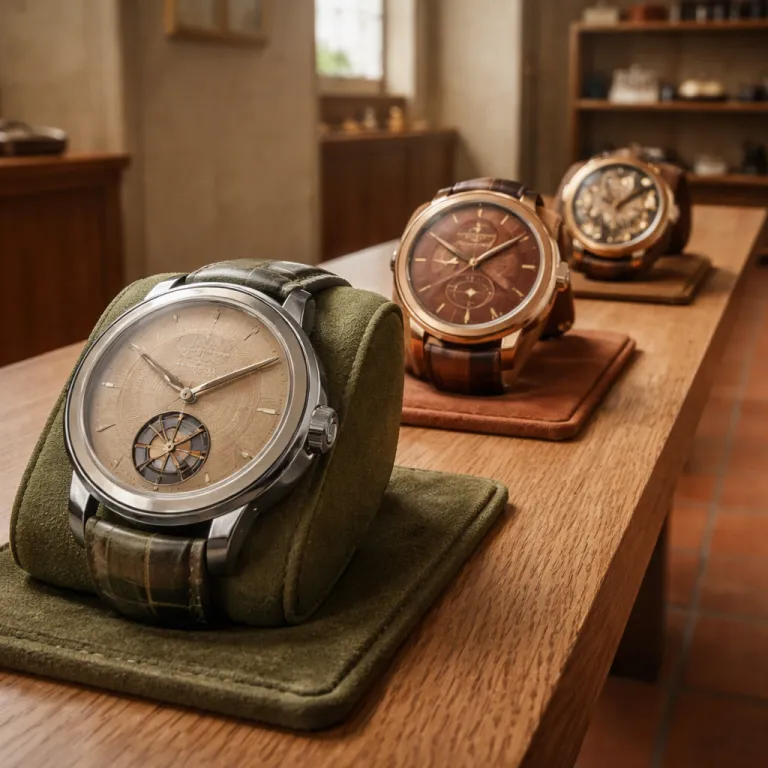
What independent really means when the waitlist is longer than Patek
Independent watchmakers in the current landscape are no longer a fringe curiosity for the seasoned collector. The term independent now usually means a watch company that is privately owned, often founder based, with full creative control over watch design, movement architecture and the final pieces leaving the atelier. In practice, that independence lives in the dial typography, the case geometry, the hand finishing and the refusal to let a marketing department dictate the next model.
For a serious watch collector comparing an independent watch brand to a historic swiss watch giant, the difference starts with structure rather than with price. Akrivia, Voutilainen, F.P. Journe or a younger name like Simon Brette are built around a single watchmaker whose signature is visible in every movement bridge, every bevel and every sapphire crystal edge, while the big watch brands are built around committees, shareholder expectations and a chf billion scale industrial footprint. That structural contrast explains why independent watchmaking can feel more fragile yet more honest than the wider watch industry, including the most established swiss names.
Independents operate in a market where production is counted in dozens or low hundreds of watches per year, not tens of thousands. That means each watch case, each dial and each automatic or hand wound movement can be obsessively refined, but it also means limited pieces, long delays and a very real succession risk if the founding watchmaker steps away. When you buy into independent watchmakers in this environment, you are buying into a human lifespan as much as into a dual time complication, a power reserve indicator or a specific level of water resistance.
Independent in this context does not mean isolation from the broader watch industry or from the united states, Europe and hong kong collector ecosystems. Many independents rely on swiss suppliers for ébauches, balance springs or sapphire crystal blanks, and some are partially based outside Switzerland while still producing a fundamentally swiss watch in spirit and execution. The key is that the watch brand retains control over design, finishing and final assembly, including the freedom to pursue vintage inspired aesthetics or radical contemporary watch design without asking a conglomerate for permission.
At the same time, the line between independent and group owned watch brands is not always clean, especially when a larger brand or investor takes a minority stake to secure long term stability. Collectors should look beyond the logo on the dial and ask who controls the movement design, who signs off the case proportions and who decides whether the next watches will be limited pieces or serial production. When those decisions still sit with the founding watchmaker and a small équipe rather than a distant board, you are usually dealing with genuine independent watchmaking rather than a marketing slogan.
Why independents now set the standard for finishing and legitimacy
The explosion of demand around independent watchmakers did not happen because of social media alone. It happened because collectors with fifteen or twenty years in the hobby put a loupe on a Voutilainen Vingt 8, an Akrivia Chronomètre Contemporain or a Laurent Ferrier Galet and realised that the movement finishing, the interior angles and the hand bevels simply outclassed most industrial swiss watch offerings at a similar price. Once you have seen that level of watchmaking up close, it becomes difficult to accept a mass produced movement with machine applied côtes and a generic rotor in a watch case costing five figures.
Three structural forces pushed independents from cult to centre stage in the watch industry, including the most conservative corners of Geneva. First, finishing quality at the top independents reached a point where even brands like Audemars Piguet quietly benchmark their own haute horlogerie against them, especially in terms of movement architecture and hand executed details. Second, allocation politics at the big watch brands turned too many buying experiences into a game of boutique loyalty points, pushing serious collectors toward independent watchmaking where a direct relationship with the watchmaker still matters more than your spend history.
The third force is fatigue with the endless limited editions and incremental dial colours coming from large watch brands that must feed a chf billion revenue machine. Independents, by contrast, can release fewer watches, focus on coherent watch design and let a single model evolve slowly through subtle case refinements, movement upgrades or new dial executions. That restraint resonates with collectors who now prefer to allocate capital to one or two deeply satisfying pieces rather than chase every new release from a mainstream watch brand.
For those mapping the landscape beyond the obvious names, there is a rich field of independent watchmakers whose work rewards close study. Laurent Ferrier offers classically proportioned swiss watch pieces with micro rotor movements and a level of hand finishing that stands up under ten times magnification, while Andreas Strehler quietly builds some of the most technically ambitious movements in the market, including exceptional power reserve management and calendar mechanisms. Petermann Bédat, still relatively young as a watch company, has already shown that a small atelier can deliver a movement whose bridges, steelwork and hand finished details rival the best from any historic brand.
Collectors who want to go deeper into this world should treat the independent scene as its own ecosystem rather than as an offshoot of the big groups. That means following dedicated coverage of independent watchmaking, reading long form interviews with watchmakers and studying detailed movement photography instead of relying on generic watches wonders headlines. A focused resource on independent watchmakers can provide a structured overview of the most important watch brands, the key models and the evolving market dynamics without drowning you in marketing language, and a good starting point is an in depth guide to exploring the world of independent watchmakers that maps this terrain with clarity.
From auction darlings to allocation puzzles for experienced collectors
At the top end of the market, independent watchmakers have moved from being a niche curiosity at auction to driving headline results. When a Voutilainen, an early F.P. Journe or a rare Akrivia crosses the block at Phillips or Christie’s, the hammer price now often outpaces comparable pieces from the traditional holy trinity, and that shift is not a temporary spike. It reflects a reallocation of collector trust toward watch brands where the founding watchmaker’s hand is still visible in every movement and every dial.
For the experienced collector, the practical question is how to approach these independents without getting trapped in a speculative bubble. Secondary market prices for certain models, such as the Akrivia Chronomètre Contemporain or the F.P. Journe Chronomètre Bleu, have reached levels where the delta between retail price and auction result can be uncomfortable if you care about long term value rather than quick flips. The smart move is to treat these watches like you would a blue chip vintage Patek, focusing on movement integrity, case condition, dial originality and documented service history rather than on the latest hype driven estimate.
Understanding what really drives the price of a rare independent watch requires the same discipline used when analysing the mechanics of valuation for a vintage Patek Philippe reference. You need to break down the watch into its components, assess the movement for originality and wear, inspect the case for over polishing, evaluate the dial for restorations and then place the whole model within the broader watch industry context. A detailed guide to what drives the price of a vintage Patek Philippe can be surprisingly transferable here, because the same logic applies when you are weighing a six figure independent against a similarly valued vintage piece from a historic brand.
Allocation is the other side of the puzzle, especially for independents whose annual production barely reaches double digits. Getting on an Akrivia or Rexhep Rexhepi list now requires patience, a clear articulation of why you want the watch and a willingness to wait years without constant pressure on the atelier. The most effective strategy is to build a genuine relationship with the watch company, understand their constraints around movement production, case making and hand finishing, and accept that limited pieces are a function of human capacity rather than artificial scarcity.
For collectors in the united states or hong kong, where access to independents can be mediated by a small number of retailers, the key is to avoid treating these watches as lottery tickets. Focus on references whose design, movement architecture and power reserve layout genuinely fit your collection, rather than chasing whatever model currently commands the highest premium. Over a ten year horizon, the independent pieces that will feel most satisfying on the wrist are rarely the ones that made the loudest auction headlines, but the ones whose watch design, case proportions and dial execution still feel right after thousands of hours of wear.
How to build a resilient independent focused collection for the next decade
Building a collection around independent watchmakers is ultimately an exercise in editing rather than accumulation. The structural reality of the watch industry, where a handful of groups control most watch brands and chase chf billion revenue targets, means that true independent watchmaking will always be constrained by human scale production. That scarcity is precisely why a strategy of buying fewer watches but buying deeper, with a focus on movement integrity, case longevity and dial legibility, makes more sense than ever.
Start by mapping your existing collection across complications, case sizes and movement types, then identify where an independent piece could add genuine depth rather than duplication. If you already own a strong automatic swiss watch from a major brand, consider a hand wound independent with a long power reserve, a clearly legible dual time display or a distinctive hour power indicator that changes how you interact with the watch. The goal is not to replace every mainstream watch brand in your box, but to let a few carefully chosen independent pieces re anchor your sense of what good watchmaking feels like on the wrist.
Technical literacy matters more in this segment than in almost any other part of the market. Understanding how hacking seconds works, how to set a dual time indication without damaging the movement and how to manage service intervals on a finely tuned independent calibre will protect both your enjoyment and your investment. A detailed guide to mastering watch hacking for precise time in luxury mechanical watches is not just a curiosity here ; it becomes a practical tool when you are dealing with low production movements where every service decision counts.
Historical perspective also helps you separate durable legacies from short lived experiments in the independent space. When you study the long arc of watchmaking, from the early swiss pioneers through the quartz crisis and into the current renaissance, you see that the brands which endure are those that balance innovation with serviceability, and that lesson applies equally to today’s independents. Names like qian Guobiao may not yet be as widely recognised as Audemars Piguet or other historic watch brands, but the same criteria of movement robustness, parts availability and long term support will determine whether their watches become cherished vintage inspired pieces or footnotes in auction catalogues.
In the end, the most compelling argument for focusing on independent watchmakers is not speculative upside or social media cachet. It is the daily experience of strapping on a watch whose case lines, dial typography, movement layout and sapphire crystal reflections were all shaped by a single coherent vision rather than by a marketing brief. That is where horological legitimacy now lives, and it is why the serious collector’s path over the next decade will be defined less by how many watches they own and more by how deeply they understand the few independent pieces they choose to live with, not the press release, but the wrist presence after ten years.
Key figures shaping the independent watchmaking landscape
- Independent watchmakers typically produce between 10 and 300 watches per year, compared with tens of thousands for major swiss groups, which structurally limits supply and reinforces long waitlists.
- At recent Geneva auctions, top independent pieces have achieved hammer prices two to three times their original retail price, while many mainstream luxury models have remained closer to retail or slightly above.
- The global swiss watch industry exports have exceeded CHF 20 billion in recent years, yet independents account for only a tiny fraction of total volume, highlighting their outsized cultural impact relative to economic scale.
- In key markets such as the united states and hong kong, a handful of specialist retailers handle a significant share of independent allocations, concentrating access and amplifying the importance of long term collector relationships.
- Power reserve indicators on many independent hand wound calibres now commonly range from 60 to 120 hours, significantly exceeding the traditional 40 to 48 hour power reserve found in many industrial automatic movements.