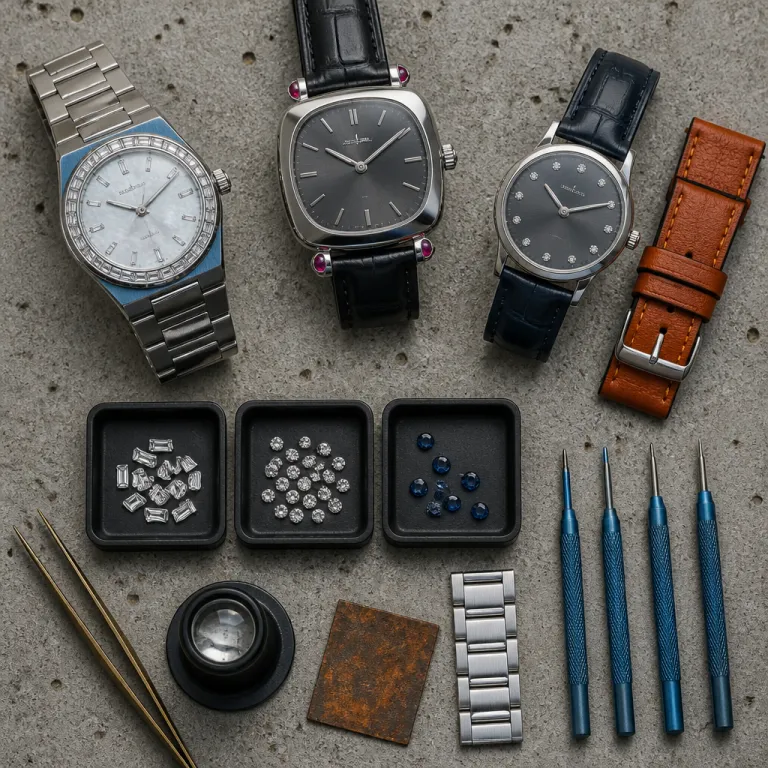
From bijoux to benchmarks: how Hans Wilsdorf reshaped luxury time
Hans Wilsdorf treated every watch as a piece of bijoux for the wrist, yet his vision for jewellery-like refinement in his luxury creations went far beyond decoration. He understood that a refined case, a luminous dial and a perfectly proportioned bracelet must serve legible timekeeping, so the decorative details on each Rolex watch or Tudor watch always reinforced function rather than distracting from it. In his view, a watch had to offer enduring precision first, while the ornamental elements elevated the emotional connection for the owner.
When collectors today view early Rolex watches, they immediately notice how the bijoux-like applied hour markers, faceted hands and fluted bezels create a royal aura without feeling ostentatious. Those same codes still define modern Rolex watches and Tudor watches, proving that the gem-like accents and sculpted cases Wilsdorf favoured were never a passing trend but a structural design language. The result is a family of timepieces where every polished surface, every chamfer and every second hand speaks of deliberate watchmaking choices rooted in Wilsdorf’s insistence that “quality is the only way to win the confidence of the public,” a line he repeated so often that early employees recalled it as the unofficial motto of the company.
Wilsdorf’s approach to bijoux also shaped how price and value are perceived in this segment, because he linked decorative refinement to measurable performance such as water resistance and chronometric precision. This is why a Rolex Oyster or an Oyster Perpetual model feels like more than a simple sport watch, since the refined finishing coexists with robust engineering that can handle real world use. For passionate collectors, that duality explains why these jewel-like Hans Wilsdorf luxury watches continue to command strong demand in both new and pre-owned markets, where buyers look for pieces that combine visual charm with proven reliability.
The Rolex Oyster and Oyster Perpetual as functional bijoux
The Rolex Oyster case transformed the idea of wrist-worn bijoux by proving that elegance could be fully waterproof. When the first Rolex Oyster was presented in 1926, the screwed crown, case back and bezel created a sealed shell that protected the movement, yet the polished lugs and refined proportions still looked like high jewellery on the wrist. This blend of technical innovation and jewellery-level finishing set a template that the Oyster Perpetual line continues to refine today, from the classic 36 mm references to the colourful modern dials.
Every modern Oyster Perpetual illustrates how Wilsdorf’s team created hand-finished details that feel almost architectural, from the smooth bezel to the sunburst dials that play with light over time. The second hand sweeps with quiet authority, while the applied indices catch reflections like discreet gemstones, giving these Rolex watches a subtle royal character without explicit diamonds. For many enthusiasts, this is the watch best suited to daily wear, because it balances sport capability with a bijoux sensibility that never feels fragile, especially in references powered by calibres such as the Rolex 3230 with its extended power reserve.
Collectors who compare an Oyster Perpetual with a more overtly luxurious Yacht-Master in yellow gold, as analysed in this in-depth look at the allure of the Yacht-Master for discerning collectors, can clearly see how Wilsdorf’s decorative language spans a wide range of expressions. At one end, the Rolex Oyster remains almost minimalist, while at the other, precious metals and bolder bezels create a more extroverted view of luxury. Yet in both cases, the underlying watchmaking philosophy remains identical, with precision, robustness and high finishing standards justifying every increment in price and reinforcing the sense that these are wearable bijoux built for real-world use.
Silent precision and the emotional power of the second hand
One of the most fascinating aspects of Hans Wilsdorf’s luxury timepieces is how they sound, or rather how they almost do not sound at all. The smooth sweep of the second hand on a Rolex watch or Tudor watch reflects a high-beat movement whose individual ticks blur into a near continuous motion, reinforcing the perception of perpetual time. This quiet behaviour has become so iconic that many enthusiasts seek explanations in dedicated analyses such as this article on the real reason Rolex watches seem silent, often discovering that the impression of silence is part engineering, part psychology.
From a design perspective, Wilsdorf understood that the second hand is not just a technical component but a visual signature, so he treated it almost like a piece of bijoux gliding over the dial. On many Rolex watches, the contrasting colour of the seconds hand, the polished counterweight and the precise alignment with the minute track all contribute to a sense of controlled energy. A long-time collector once described watching the seconds hand on his first Oyster Perpetual as “like seeing a tiny comet trace the same orbit every day,” capturing how these small details can turn routine time checks into quiet rituals.
That same philosophy extends to Tudor watches, where the famous snowflake hand set offers a more sport-oriented interpretation of dial-side jewellery. Whether on a Tudor Black Bay or a Rolex Oyster model, the hands and indices are finished to a high standard that rewards close inspection under different light conditions. For collectors, these details justify both the initial price and the strong retention of value in the pre-owned market, since true precision finishing never goes out of style and continues to define Wilsdorf’s legacy of functional bijoux.
Tudor as Wilsdorf’s second pillar of accessible bijoux
When Hans Wilsdorf created Tudor in 1926 and later relaunched it in the mid-20th century, he wanted a second brand that could offer the spirit of Rolex watches at a more accessible price point. This strategic move allowed him to extend his concept of refined, jewellery-like tool watches to a wider audience without diluting the Rolex name. Tudor watch models shared many design cues with Rolex, including Oyster-style cases and robust movements, but they were positioned as the watch best suited for professionals seeking reliability over overt prestige.
Modern Tudor watches such as the Black Bay and Pelagos continue this mission, combining sport aesthetics with high-end details like chamfered lugs, gilt dials and finely brushed bracelets. Ambassadors such as David Beckham and Jay Chou reinforce this dual identity, since both figures embody a mix of high performance and refined style that mirrors the Tudor philosophy. Campaigns featuring David Beckham often highlight the rugged elegance of a Tudor watch, while Jay Chou appears as an artist ready for creative challenges that demand both precision and personality, echoing Wilsdorf’s belief that a watch should accompany people who push their own limits.
Marketing narratives sometimes play with cinematic imagery, evoking a Taipei-meets-Hollywood atmosphere where Jay Chou moves through dynamic cityscapes wearing a Tudor watch that feels like modern bijoux. These stories underline how Wilsdorf’s second brand has become a cultural force in its own right, not merely a junior partner to Rolex. For collectors, Tudor offers a wide range of sport-oriented pieces whose finishing and history make them compelling both at retail and in the pre-owned segment, especially when seeking the best price-to-value ratio in the broader universe of Hans Wilsdorf luxury watches.
Celebrity narratives and the modern view of Wilsdorf’s legacy
Contemporary campaigns show how Wilsdorf’s jewel-like tool watches now live on the wrists of global icons, translating his original ideas into modern storytelling. When Jay Chou appears in Tudor advertisements, the narrative often suggests that artists ready to push boundaries face each new challenge with a watch that symbolises both discipline and flair. This framing echoes how Wilsdorf saw timepieces as tools for people who challenge takes on life rather than passively measuring hours, a philosophy that still resonates with younger collectors discovering the brands today.
Similarly, David Beckham’s association with Tudor watches reinforces the link between sport performance and refined bijoux aesthetics, since his image bridges stadiums and red carpets. Campaigns sometimes evoke a Taipei–Hollywood blend of cultures, where international glamour meets urban grit, and the watch remains the constant companion. In these stories, the Tudor watch or Rolex watch is never just an accessory; it is a visible sign of commitment to precision, resilience and personal history, a small but constant reminder of goals set and milestones reached.
Rolex itself rarely leans on overt celebrity endorsements, yet its presence on the wrists of explorers, athletes and leaders reflects the same underlying narrative that Hans Wilsdorf crafted. The brand’s communication focuses on achievements in sport, science and the arts, presenting Rolex watches as refined instruments that celebrate human milestones rather than mere status. For enthusiasts, this view of Wilsdorf’s bijoux-inspired luxury watches helps explain why certain references become cultural icons whose value transcends simple price comparisons and continues to grow as stories accumulate around them.
Collecting strategy, price dynamics and the role of pre owned pieces
For serious collectors, approaching Hans Wilsdorf’s luxury creations requires a clear strategy that balances passion with financial discipline. The primary market for Rolex watches and Tudor watches often presents waiting lists, so many enthusiasts turn to the pre-owned space where availability is higher but price dynamics can be complex. Understanding how history, condition and rarity interact is essential when deciding whether a Rolex watch or Tudor watch offers the best price to long-term value, especially when factoring in future service costs and potential appreciation.
One effective approach is to focus on core designs such as the Rolex Oyster, Oyster Perpetual and key Tudor sport models, because these references embody the purest expression of Wilsdorf’s watchmaking philosophy. Collectors can then build a wide range of variations in size, dial colour and metal, treating each piece as a distinct bijoux chapter in their personal story. Comparative research, including reading analyses like this study of why the Patek 5065A Aquanaut remains a modern luxury icon on the enduring appeal of the Aquanaut, helps refine one’s view of value across different brands and clarifies where Rolex and Tudor sit in the broader landscape.
As markets evolve, collectors should remain ready to challenge assumptions about which references will perform best over time, since taste cycles and supply constraints can shift. The key is to prioritise pieces where the decorative refinement of Wilsdorf’s designs is backed by robust movements, strong brand history and enduring design, rather than chasing short-term hype. In that sense, every acquisition becomes a deliberate act where Hans Wilsdorf’s principles guide both the heart and the hand that ultimately fastens the clasp, turning each watch into a personal talisman as well as a precise instrument.
Key figures shaping the legacy of Hans Wilsdorf’s bijoux
- Rolex produces an estimated one million watches per year, a scale that allows the brand to maintain high in-house quality control while sustaining global demand for Wilsdorf’s refined luxury tool watches (industry estimates based on Swiss export statistics and market analyses, including Morgan Stanley & LuxeConsult Swiss Watch Industry Report 2023).
- Swiss watch exports reached approximately 24 billion Swiss francs in recent years, with Rolex and Tudor together representing a significant share of the mechanical segment, underscoring how Wilsdorf’s brands dominate the high-end sport and dress categories (Fédération de l’industrie horlogère suisse, annual export reports, 2022–2023).
- Pre-owned luxury watch sales have grown to represent more than 30% of the overall market value, reflecting how collectors increasingly view Rolex watches and Tudor watches as long-term assets rather than simple purchases (Boston Consulting Group and WatchBox joint market studies, “The Pre-Owned Watch Market,” 2019 and subsequent updates).
- Average service intervals for modern Rolex and Tudor mechanical movements are recommended at around ten years, a figure that highlights the durability and precision engineering behind Wilsdorf’s creations (official brand service guidelines published by Rolex SA and Montres Tudor SA, updated in the late 2010s).
- Water-resistance ratings for core Oyster and Tudor sport models typically start at 100 metres and extend to 300 metres or more, demonstrating how Wilsdorf’s original Oyster concept still defines the technical benchmark for everyday luxury tool watches (brand technical specifications and catalogue data for models such as the Rolex Submariner and Tudor Pelagos).
FAQ about bijoux on Hans Wilsdorf luxury watches
Why are Rolex and Tudor often described as bijoux on the wrist ?
Rolex and Tudor watches are described as bijoux because their cases, dials and bracelets receive a level of finishing usually associated with fine jewellery, yet they remain engineered as robust instruments. Hans Wilsdorf’s philosophy combined precision movements with refined aesthetics, so every second hand, index and bezel is treated as a design element. This dual nature explains why many collectors view these watches as both tools and personal ornaments.
How does the Oyster case influence the value of a Rolex watch ?
The Oyster case is central to the value of a Rolex watch because it delivers reliable water resistance and protects the movement from shocks and dust. This technical security allows the brand to maintain high accuracy over long periods, which supports both functional trust and resale value. Collectors often prioritise Oyster and Oyster Perpetual models when building a core collection of bijoux on Hans Wilsdorf luxury watches.
What differentiates Tudor watches from Rolex watches in terms of price and positioning ?
Tudor watches are positioned at a lower price point than Rolex, offering many of the same design principles and sport capabilities with slightly simpler materials or finishing. This makes Tudor an attractive entry into the world of bijoux on Hans Wilsdorf luxury watches for enthusiasts who prioritise performance and heritage. Rolex, by contrast, focuses on higher levels of in-house movement development, precious metals and long-term brand prestige.
Are pre owned Rolex and Tudor watches a safe way to collect Wilsdorf’s creations ?
Pre-owned Rolex and Tudor watches can be a very effective way to access discontinued references, rare dial variants or more favourable prices, provided that authenticity and condition are carefully verified. Working with reputable dealers, requesting service histories and examining case, dial and movement details are essential steps. Many collectors view the pre-owned market as a natural extension of Wilsdorf’s legacy, since it keeps his bijoux creations circulating across generations.
How should a new collector plan a first purchase of a Hans Wilsdorf watch ?
A new collector should begin by defining the primary use case, whether daily wear, sport activities or formal occasions, then shortlist Rolex or Tudor models that match this lifestyle. Comparing Oyster Perpetual, classic Oyster and key Tudor sport references helps clarify which design language resonates most strongly. From there, evaluating price, availability and long-term service support ensures that the chosen piece of bijoux on Hans Wilsdorf luxury watches will remain satisfying for many years.